





SURKHET: Birendranagar, the capital of Karnali Province, is facing an acute drinking water crisis, with supply now limited to once every four days due to ongoing drought conditions.
The Surkhet Valley Drinking Water Consumers’ Association, which manages the water distribution in the area, has announced that water will now be delivered to household taps every 96 hours, as the drying of natural water sources has severely impacted supply.
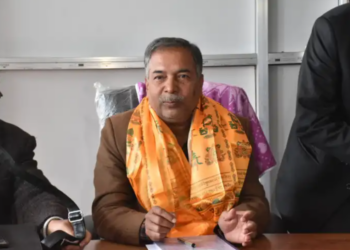
According to Dambar Bahadur Gautam, the office chief of the association, the situation has worsened in recent years due to rapid urbanization, which has increased water demand while sources continue to shrink.
He noted that without alternative solutions, the problem is likely to persist. The association currently supplies water to around 20,000 consumers, but despite increasing demand, no new water taps have been installed in recent years due to limited resources.
Under normal conditions, the city requires 388 liters of drinking water per second to meet daily needs.
Even during the rainy and winter seasons, the total water available reached only 158 liters per second, sourced from rivers such as Jhupra, Kharikhola-Borikhola, Itram, Dundure, and Khorke.
In the first phase, water from the Bheri River will be lifted through five kilometers of steel piping to a reservoir in Amritdanda, located in Birendranagar-10, with a total storage capacity of nine million liters.
However, the ongoing drought has caused these sources to dry up further, reducing the current supply to just 90 liters per second.
Chief engineer Balaram Tiwari explained that due to the valley’s uneven terrain, some households may receive water while others do not. He urged residents to report such issues to the office.
While the system consists of nine distribution schemes, only three are currently experiencing serious difficulties.
The original drinking water project, designed to serve from 2062 to 2077 BS, has already exceeded its operational timeline.
With the population of Birendranagar now surpassing 200,000, the outdated infrastructure is unable to meet current demands.
Although experts have been calling for a review of the project since 2068 BS, warning that the 25-year-old water sources can no longer sustain the valley, no steps have been taken by the government so far.
Bheri water to be pumped to Birendranagar
Construction has begun on the first phase of the much-anticipated Bheri Pumping Project, which is expected to serve as a long-term alternative solution to the drinking water crisis in Birendranagar Municipality.
In the Nepali month of Bhadra, the contract for this large-scale project was awarded to the Chinese company Xinjiang Times International Economy and Technical Co-operation.
The project, valued at Rs 3.58 billion, has already seen expenditures totaling Rs 263 million within the first four months, up to the end of the Nepali month of Poush.
For the current fiscal year, a total budget of Rs 1.22 billion has been allocated for the project. This includes Rs 1.16 billion from the federal government, Rs 35 million from the Karnali provincial government, and Rs 10 million from Birendranagar Municipality.
The federal government is expected to contribute 80 percent of the total estimated cost of Rs 6 billion, while the remaining 20 percent will be shared by the provincial government and the municipality.
In addition to financial contributions, the municipality is also responsible for supporting local-level infrastructure work—such as resolving disputes and expanding access roads—to ensure smooth project execution.
With permission already granted for tree felling in the project area, the municipality has reported that construction work is progressing rapidly, with the goal of supplying Bheri water to the valley within the next two and a half years.
In line with the principles of federalism, all three tiers of government—federal, provincial, and local—are collaborating to implement the project.
The Bheri Lift Drinking Water Project is currently in full swing, aiming to address Birendranagar’s persistent water shortage. The contractor has completed a joint survey, set up a crusher plant, batching plant, and a materials testing lab to support construction.
In the first phase, water from the Bheri River will be lifted through five kilometers of steel piping to a reservoir in Amritdanda, located in Birendranagar-10, with a total storage capacity of nine million liters.
An additional 29 kilometers of pipelines will be laid, and the project will pump 560 liters of water per second from the river.
Once completed, the system is expected to supply clean drinking water to 13 out of the 16 wards of Birendranagar Municipality.



Comment