




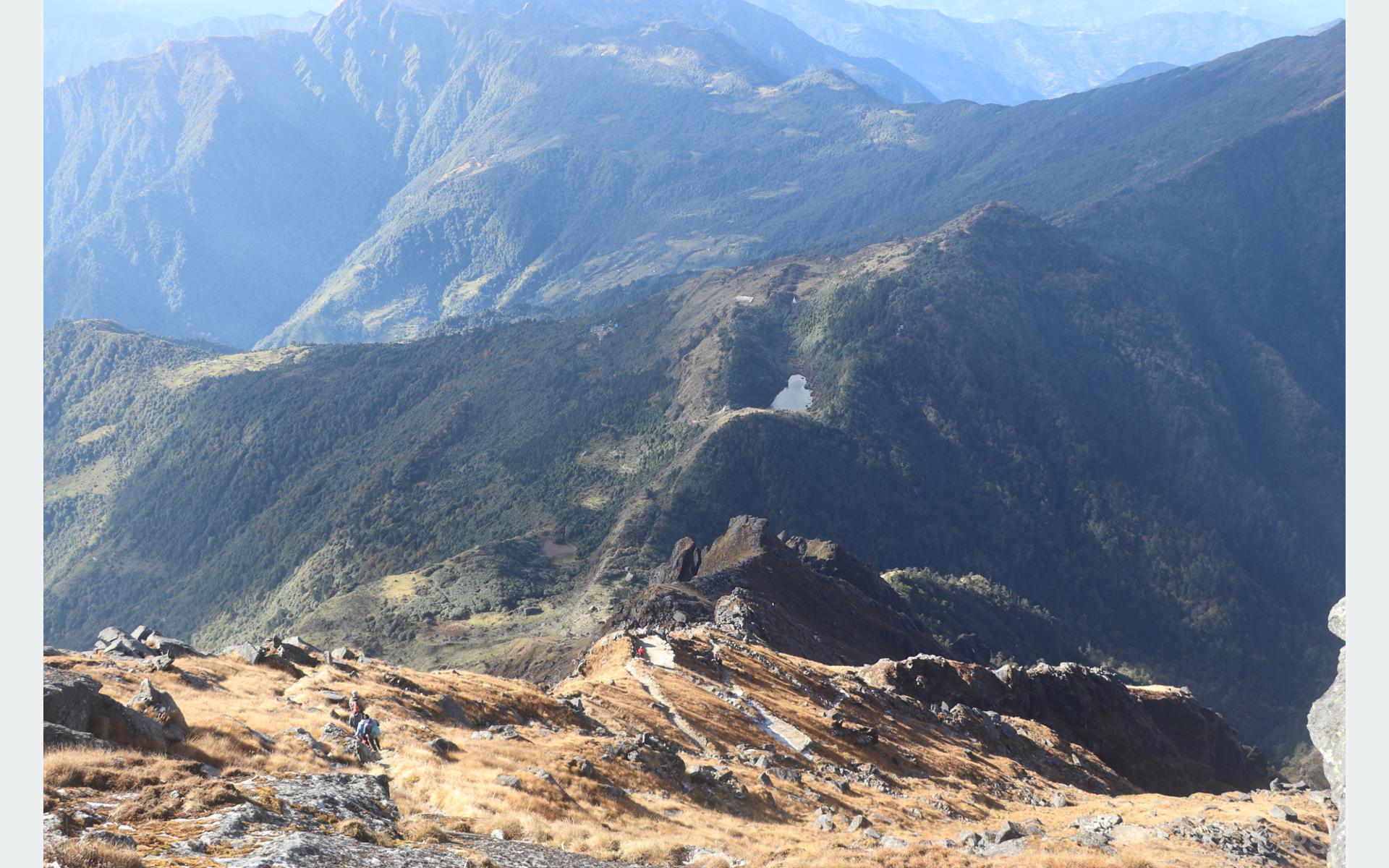
BHOJPUR: The majestic Salpa–Silichung Peak and Salpa Lake in Bhojpur district are rapidly gaining popularity as key attractions among both domestic and international tourists.
Situated along the Mundum trekking route, the area has become a must-visit destination for nature lovers, adventure seekers, and spiritual pilgrims alike.
Standing at an elevation of 4,155 meters above sea level, Silichung Peak offers breathtaking panoramic views of Mount Everest and other Himalayan peaks. Tourists are increasingly drawn to the area for its stunning mountain vistas and serene natural beauty.
Nestled at the base of the peak is Salpa Lake, a site of deep religious significance. Many devotees visit the lake believing that their wishes will be fulfilled. A religious fair is held four times a year—on the full moon days of March, April, September, and October — attracting large crowds of worshippers from Bhojpur, Khotang, Sankhuwasabha, Dhankuta, and Solukhumbu districts.
According to local beliefs, the lake blesses childless couples with children and grants speech to the speechless. The bowl-shaped Salpa Pond is especially famous for the myth that its water changes color periodically. For the Kirat Rai community, it is worshipped as an ancestral deity.
Local cultural expert Chandra Khatri believes that if the Salpa–Silichung area is developed and promoted in a structured manner, it has the potential to become a major religious and tourism hub—on par with Pathibhara Temple in Taplejung.
“People trek for four to five days to reach this sacred site with strong belief in its spiritual powers,” he said.
Adding to its historical value, it is said that Tenzing Norgay and Sir Edmund Hillary used this very trail during their historic expedition to Mount Everest.
With its unique blend of natural beauty, religious faith, and historical significance, Salpa Lake and Silichung Peak are fast emerging as major tourist destinations.
Locals emphasize that with proper conservation efforts, infrastructure development, and promotion, the area could be established as one of Nepal’s prominent religious and eco-tourism centers.





Comment