




Nearly two decades after the 2006 People’s Movement dismantled Nepal’s absolute monarchy and established a secular federal democratic republic, the country faces a critical juncture. Nepal’s political landscape was shaped by Transformers (those seeking to radically restructure the system, like the Nepal Communist Party Maoists Center) and Transforms (those seeking incremental reforms within the existing framework).
The 2015 Constitution, adopted following the post-conflict as well as the peaceful people’s uprising, was intended to consolidate democratic gains and establish institutional stability. Yet successive governments have struggled to deliver coherent governance, economic reform, or institutional capacity.
Concurrently, the Gen Z–led civic awakening and the dramatically shifting political terrain—particularly demands for constitutional accountability and administrative reform—have exposed widening gaps between state performance and societal expectations.
These developments have activated four structural tensions that merit analytical attention: an emerging contestation over institutional legitimacy; a generational leadership divide; constitutional vulnerabilities; and the persistent prioritization of partisan survival over national strategy.
These faultlines represent neither aberrations nor uniquely Nepali phenomena. Rather, they reflect patterns observable across democracies managing rapid social modernization, institutional fragility, and generational transition. Understanding their configuration is essential for assessing Nepal’s political trajectory.
Institutional Legitimacy Under Question: Republic and Monarchy Reconsidered
For approximately fifteen years following the 2006 transition, the republican framework maintained broad elite consensus, if not universal popular endorsement. However, recent survey data and political discourse suggest a notable shift.
A 2023 Kathmandu-based opinion survey found that approximately 38–42 percent of respondents expressed openness to “reconsidering Nepal’s institutional framework,” a marked increase from comparable surveys conducted in 2015–2017. This shift is attributed to royalist nostalgia, correlated dissatisfaction regarding governance performance, corruption indices, and state delivery capacity.
While the general trend of dissatisfaction and corruption is widely documented in various reports such as those by Transparency International and The Asia Foundation, the sentiment in Kathmandu, in particular, tends to be more cynical about the country’s direction compared to other regions.
The resurgence of monarchy-related discussions reflects a particular logic: in the absence of perceived institutional performance, segments of the population view pre-2006 institutional arrangements—specifically the constitutional monarchy—as having provided greater predictability and security.
Nepal is entering one of the most decisive political moments since the 2006 People’s Movement and the 2015 Constitution. A generation ago, the country was driven by two broad forces: the Transformers, who sought radical political change, and the Transforms, who aimed for gradual reform within the existing order.
This is fundamentally a performance-based critique of republicanism, an ideological shift in addition to an endorsement of losing strategic national credibility. Political parties historically committed to republicanism now exhibit internal heterogeneity on this question, with some members privately acknowledging concerns about current institutional effectiveness.
This phenomenon parallels developments in other post-conflict or post-authoritarian democracies. Sri Lanka’s 2022 political crisis, precipitated by economic collapse and governance failure, generated renewed discussions regarding presidential powers and institutional checks—effectively reopening questions considered settled in the 1978 Constitution.
Similarly, Thailand’s oscillations between democratic reform movements and monarchy-centred governance reveal how unresolved questions of institutional legitimacy resurface during crises of state capacity.
The significance of this faultline lies both in the probability of formal constitutional reversion and in those who oppose it. It indicates weakened confidence in existing institutional arrangements. This erosion of institutional consensus, if sustained, may constrain the range of feasible policy options available to Nepal’s leadership.
Generational Discontinuity: Leadership Succession and Political Culture
The September 2025 youth mobilizations demonstrated unprecedented coordination among Nepal’s youth cohort, notably leveraging digital platforms and transnational networks. Survey data from the Nepal Youth Foundation (2023) indicates that 64 percent of respondents aged 18–35 perceive Nepal’s political leadership as “disconnected from contemporary governance standards,” compared to 41 percent of respondents aged 45 and above.
This generational divergence reflects not merely a preference for younger politicians, but a fundamental disagreement regarding acceptable governance practices.
Traditional Nepalese political structures—characterized by patronage networks, factional hierarchies, and dynastic succession patterns—operate according to mechanisms that younger cohorts find categorically delegitimizing.
The explicit rejection of “political inheritance” as a selection criterion for leadership, evident in protest rhetoric and social media discourse, signals demand for merit-based nomination processes and transparent institutional governance.
International parallels illuminate this dynamic. Malaysia’s 2018 electoral transition, in which the Pakatan Harapan coalition defeated the 61-year incumbent Barisan Nasional regime, was substantially driven by youth mobilization against perceived governance failures and corruption.
Post-election analysis indicated that voters aged 18–40 constituted 62 percent of the anti-incumbent vote. Similarly, France’s 2017 presidential election, in which Emmanuel Macron’s En Marche movement displaced both centre-left and centre-right establishments, reflected urban and younger voters’ rejection of traditional party structures perceived as unresponsive to contemporary needs.
Nepal’s political class faces an analogous challenge: adaptation of recruitment, internal democracy, and decision-making processes to accommodate generational expectations, or risk further marginalization in electoral competition. The trajectory of this adaptation remains uncertain and may vary substantially across different parties.
Constitutional Architecture Under Strain
Nepal’s 2015 Constitution, negotiated amid post-conflict political compromise, incorporates several structural ambiguities intended as pragmatic solutions to irreconcilable differences among constituent assemblies. These ambiguities have become increasingly problematic as coalition instability and leadership mistrust have converted constitutional provisions into contested terrain.
Specific pressure points include: the demarcation of executive-legislative powers; the delineation of federal, provincial, and local authority (particularly regarding revenue generation and resource allocation); and the mechanisms for constitutional amendment. Nepal has experienced seven government transitions between 2015 and 2024, with coalition dissolution accounting for five instances.
This frequency of government turnover correlates with policy discontinuity; for instance, infrastructure investment priorities have shifted substantially with each change of government, complicating long-term planning capacity.
More problematically, successive political actors have invoked constitutional provisions to justify contradictory actions. The ambiguously worded Article 76 (concerning executive authority to dissolve parliament) generated legal contestation in 2020–2021, ultimately requiring Supreme Court intervention.
Similar disputes regarding fiscal federalism provisions remain partially unresolved, creating ongoing tensions between central and provincial governments regarding resource allocation.
Comparable constitutional systems illuminate potential trajectories. Pakistan’s 1973 Constitution, drafted amid similar post-conflict compromise, has experienced recurring institutional crises precisely because foundational ambiguities regarding executive-judicial-legislative relationships remain unresolved after five decades.
Italy’s 1948 Constitution, while substantially more robust, has generated chronic governance instability partly attributable to ambiguous power-sharing provisions that incentivized frequent coalition fragmentation.
The critical variable for Nepal is whether constitutional ambiguities can be clarified through consensual amendment and institutional interpretation, or whether accumulated strain will progressively erode constitutional authority. Current indicators suggest incremental erosion rather than acute rupture, but the trajectory remains contingent upon political actors’ willingness to prioritize constitutional stability over partisan advantage.
Institutional Incentive Misalignment: Partisan Survival and National Strategy
Perhaps most consequentially, Nepal’s political system structurally incentivizes short-term partisan calculation over long-term national strategy. Coalition governments, dependent upon maintaining heterogeneous partners, face substantial constraints in implementing sustained policy reforms.
This misalignment manifests across multiple domains: foreign policy exhibits inconsistency reflecting coalition shifts rather than coherent national positioning; economic reform initiatives have been repeatedly suspended following government transitions; and infrastructure decisions frequently reflect political calculus regarding regional representation rather than developmental efficiency.
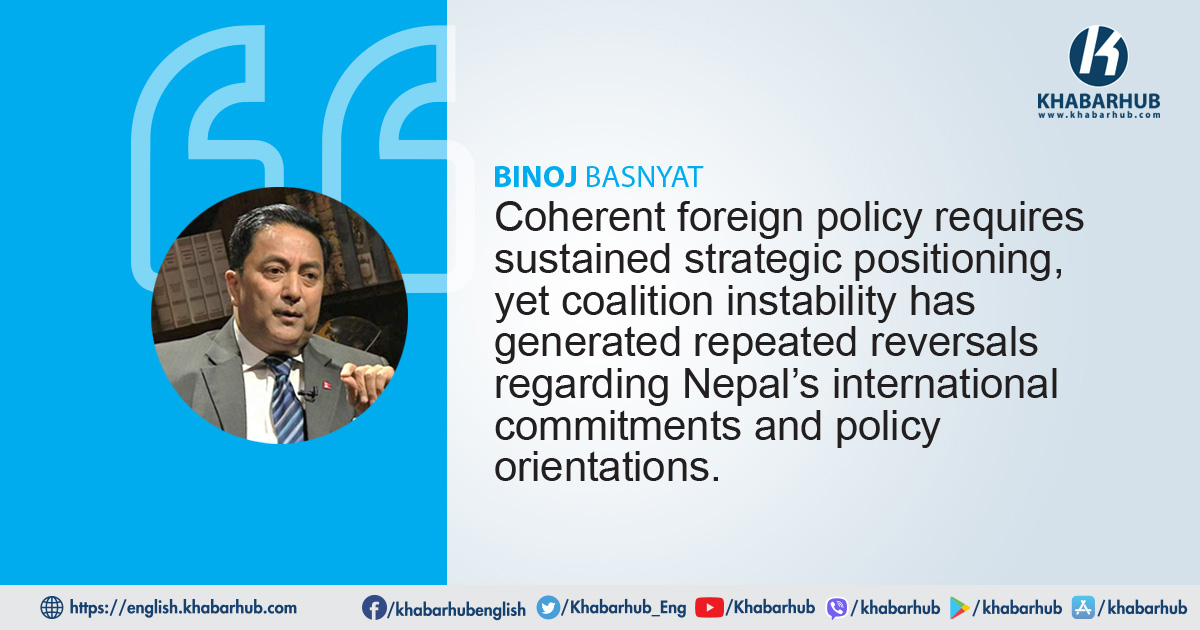
Nepal’s geopolitical position—situated between two major regional powers—compounds this challenge. Coherent foreign policy requires sustained strategic positioning, yet coalition instability has generated repeated reversals regarding Nepal’s international commitments and policy orientations.
Whether Nepal’s political structures can adapt to these demands while maintaining democratic legitimacy remains the central question defining the nation’s political future.
For instance, Nepal’s approach to BIMSTEC, Shanghai Cooperation Organisation (SCO) participation, and presence in the 80th Victory Day Parade of China—which brought 20 heads of state and senior representatives from multiple countries—has shifted substantially with each government transition, constraining Nepal’s credibility with external interlocutors.
Former PM Oli wrote on X: “This morning, I attended the commemorative events at Tiananmen Square in Beijing, marking the 80th anniversary of the Victory of the Chinese People’s War of Resistance and the World Anti-Fascist War.”
Structural parallels with other fragmented democracies are instructive. Argentina’s chronic political fragmentation, combined with economic vulnerabilities, has generated cyclical policy reversals that substantively constrained the nation’s economic reform trajectory. Israel’s frequent elections—thirteen between 2006 and 2024—have repeatedly interrupted security planning, infrastructure development, and regional diplomatic initiatives.
While these cases represent more extreme fragmentation than Nepal currently exhibits, they illustrate the cumulative costs of sustained institutional misalignment between coalition stability and policy implementation.
Conclusion: Critical Juncture and Contingent Outcomes
Nepal is entering one of the most decisive political moments since the 2006 People’s Movement and the 2015 Constitution. A generation ago, the country was driven by two broad forces: the Transformers, who sought radical political change, and the Transforms, who aimed for gradual reform within the existing order.
Today, the context has changed. The Seven Party Alliance and the Nepal Communist Party Maoists revolution have ended, the monarchy has been dismantled, and an inclusive republic has been established. Yet the deeper structural challenges that define state legitimacy, leadership credibility, and constitutional coherence remain unresolved even after two decades.
Nepal’s current political configuration represents a genuinely indeterminate moment. The simultaneous activation of these four faultlines—institutional legitimacy contestation, generational leadership discontinuity, constitutional ambiguity erosion, and incentive misalignment—creates conditions of heightened political fluidity.
The trajectory toward greater institutional coherence or progressive fragmentation remains substantially contingent upon political elites’ willingness to prioritize institutional stability and long-term governance capacity over immediate partisan advantage.
The Gen Z mobilizations signal that societal demand for institutional reform and governance effectiveness is genuine and consequential, while the country faces either a constitutional crisis or an election with strategic challenges, which may not meet public expectations.
Whether Nepal’s political structures can adapt to these demands while maintaining democratic legitimacy remains the central question defining the nation’s political future.
(Basnyat is Maj. Gen. (Retd.) and a strategic affairs analyst based in Kathmandu. He writes on South Asian geopolitics, national security, and the intersection of governance, diplomacy, and stability.)





Comment