




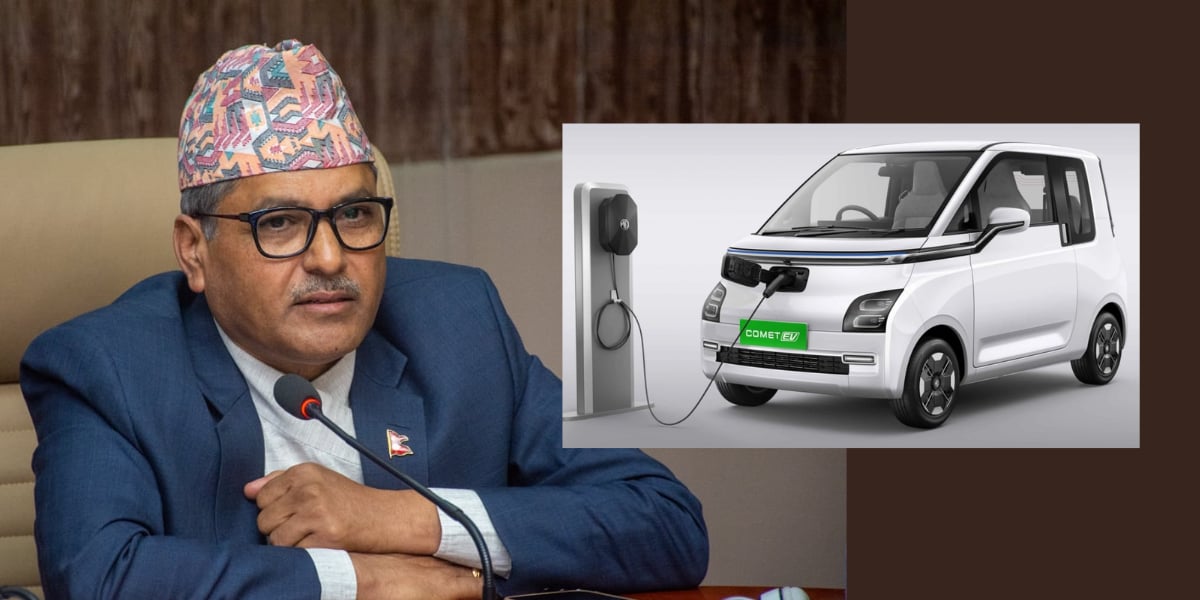
KATHMANDU: Nepal Rastra Bank (NRB) Governor Maha Prasad Adhikari has introduced a policy change that contradicts the government’s push for green energy as he nears the end of his tenure.
Despite the government’s commitment to promoting energy, hydropower, climate action, and environmental sustainability, Adhikari’s mid-term review of the current fiscal year’s monetary policy discourages the adoption of electric vehicles (EVs).
In the review published on February 25, NRB revised its loan-to-value (LTV) ratio for vehicle financing, equating the lending limit for both EVs and petroleum-fueled vehicles. This adjustment diverges from the government’s recent efforts to promote electric mobility.
Previously, the LTV ratio was set at 80% for EVs and 50% for petroleum vehicles. However, the new policy sets a uniform 60% LTV ratio for both categories, reducing the financial incentive for buyers to opt for electric vehicles.
Stakeholders have raised concerns that this decision undermines efforts to encourage EV adoption. The Automobile Association of Nepal (NADA) criticized the policy revision, stating that it neglects the government’s commitment to green energy.
“The government has prioritized green energy and introduced special incentives for electric vehicles. However, the latest monetary policy review disregards this policy direction,” NADA stated.
Government’s green energy commitments
The government has been actively promoting green energy through various policies. The Environment-Friendly Transport Policy 2014 had set a target for 20% of all vehicles in Nepal to be environment-friendly by 2020, though implementation has been lacking.
Similarly, the National Climate Change Adaptation and Mitigation Implementation Plan (2023-2030) aims to ensure that by 2025, 25% of all two-wheeler and four-wheeler private vehicle sales, and 20% of public vehicle sales, are electric.
By 2030, the plan targets 90% of two-wheeler and four-wheeler private vehicle sales and 60% of public vehicle sales to be electric.
The National Environment Policy 2019 emphasizes promoting electric, hybrid, and hydrogen-fueled vehicles, while the National Climate Change Policy 2019 highlights low-carbon economic growth as a key objective.
Furthermore, successive national budgets have introduced programs to reduce carbon emissions. However, NRB’s latest policy revision could hinder progress toward these commitments.






Comment