




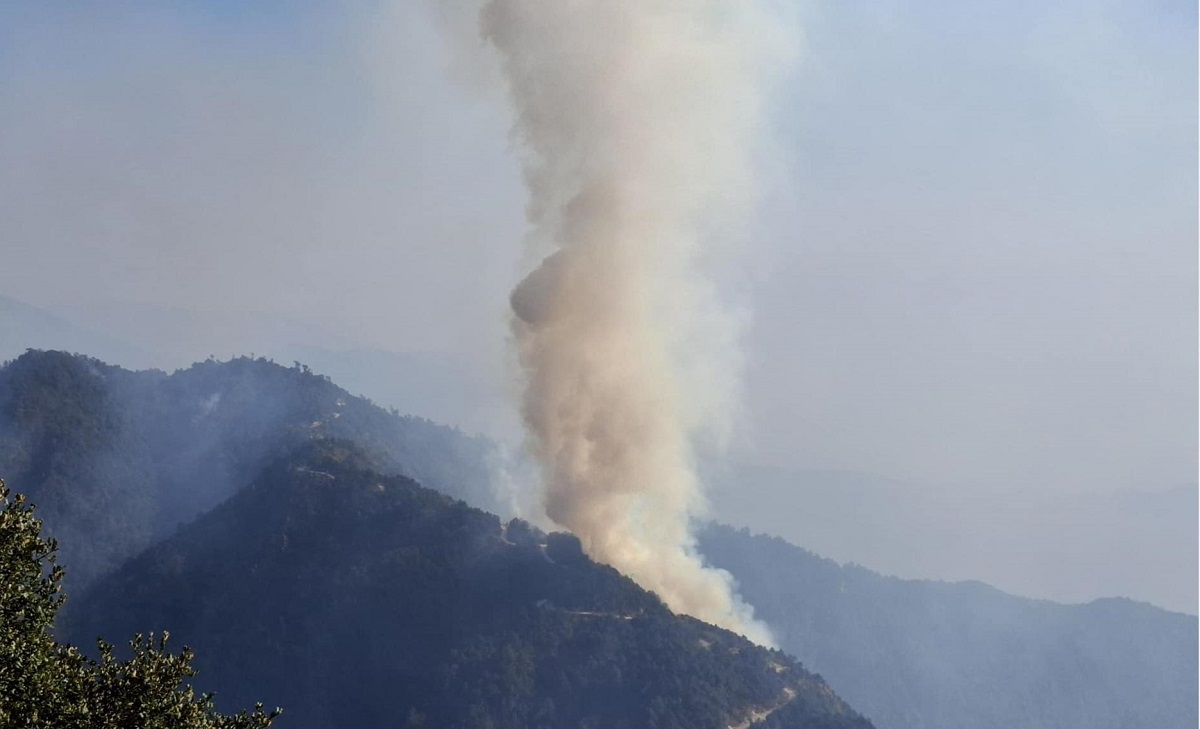
KATHMANDU: Wildfires are releasing a dangerous mix of pollutants that can travel across continents and severely degrade air quality, the United Nations’ weather and climate agency has warned.
The World Meteorological Organization (WMO) said Friday that air quality is closely linked to climate change, and both issues must be addressed together. In its fifth annual Air Quality and Climate Bulletin, the WMO highlighted how wildfires in the Amazon, Canada, and Siberia have demonstrated the global impact of smoke and particulate pollution.
“Climate impacts and air pollution respect no national borders — as exemplified by intense heat and drought which fuels wildfires, worsening air quality for millions of people,” said WMO Deputy Secretary-General Ko Barrett.
The bulletin examined the role of tiny airborne particles called aerosols, which come from wildfires, winter fog, shipping emissions, and urban pollution. Particles smaller than 2.5 micrometres (PM 2.5) are particularly harmful because they can penetrate deep into the lungs and cardiovascular system.
Wildfires in 2024 led to above-average PM 2.5 levels in Canada, Siberia, and central Africa, with the Amazon basin recording the largest surge.
“The wildfire season has the tendency to be stronger and longer every year as a result of climate change,” said WMO scientific officer Lorenzo Labrador. He noted that Canadian wildfires have caused air pollution as far away as Europe in recent years.
“What we have from these fires is essentially a witches’ brew of components that pollute the air,” Labrador said, emphasizing the transboundary nature of wildfire smoke.
Air pollution currently contributes to more than 4.5 million premature deaths globally each year, according to the World Health Organization. The WMO urged better monitoring and stronger policies to protect human health, reduce economic losses, and limit environmental damage.
The bulletin flagged northern India, particularly the Indo-Gangetic Plain, where rising air pollution and longer-lasting winter fog have been linked to agricultural biomass burning. “Persistence of fog is no longer a simple, seasonal weather event — it is a symptom of escalating human impact on the environment,” the report said.
Meanwhile, eastern China showed significant improvement in PM 2.5 levels last year, thanks to sustained pollution mitigation measures. “When countries take measures to combat poor air quality, the improvement can be clearly seen in meteorological data,” said Paolo Laj, WMO Global Atmosphere Chief.
He cited long-term improvements in cities like Shanghai, Beijing, and many in Europe and the United States. “Over a 10-year period, Chinese cities have improved their air quality in a dramatic way. It’s really impressive what they have done,” Laj said.
While there is no single solution to air pollution, Laj emphasized that coordinated action — such as emissions control and cleaner technologies — can deliver measurable results. “In Europe, we don’t realize what we were breathing in 20 years ago, but it was much worse than today,” he added.






Comment