




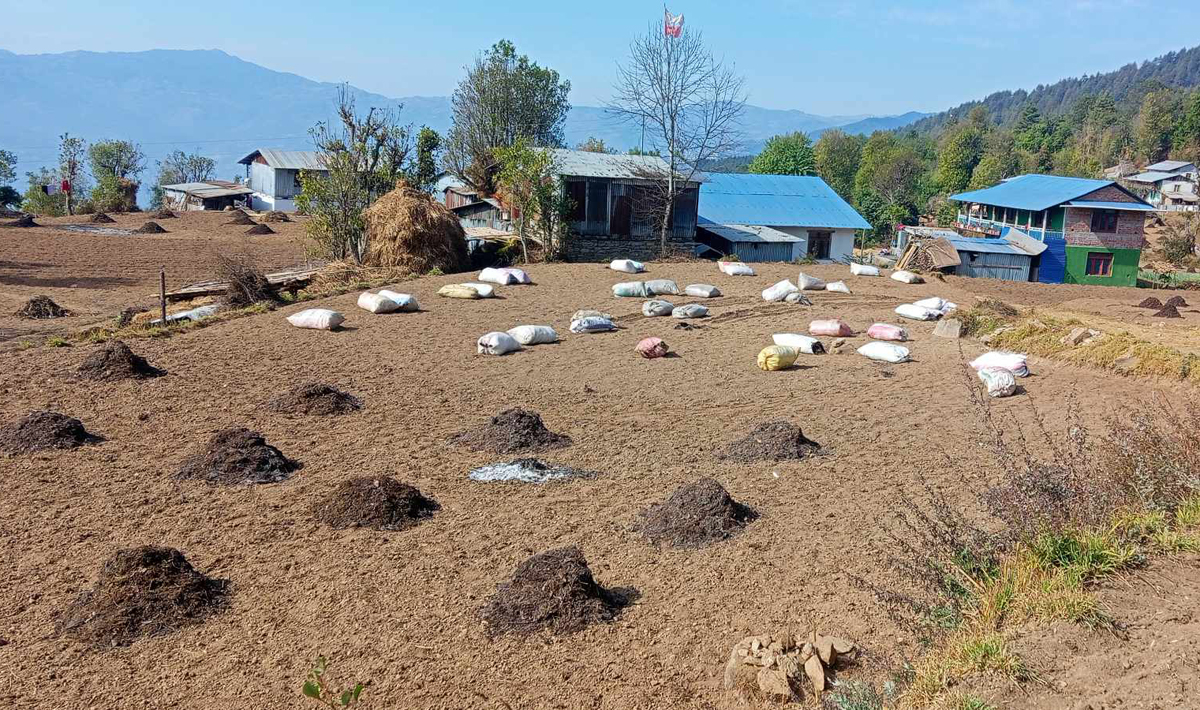
KATHMANDU: This winter has passed without significant rain or snowfall in all three regions of Nepal: the Himalayas, hills, and Terai.
The absence of snow in the Himalayas and lack of rainfall in other regions will reduce winter crop production.
The Weather Forecasting Division has estimated that this year’s rainfall will be less than average.
The below-average winter rainfall is expected to negatively affect both Nepal’s electricity and agriculture sectors.
With the dry season continuing, there has already been a notable decline in electricity production.
Experts in relevant fields have also estimated that some winter crops will be adversely affected.
No possibility of average rainfall this winter
According to the Department of Hydrology and Meteorology, the winter rainfall this year will be below average compared to previous years.
Meteorologist Sudarshan Humagain from the Department stated that Nepal has received only 5.5 millimeters of average rainfall so far.
He further indicated that the possibility of significant rainfall in the coming days is low, with only 60 millimeters expected during the winter.
“While the average winter rainfall is typically 60 millimeters, we have received only 5.5 millimeters so far, making this winter unusually dry,” Humagain explained.
He also mentioned that the department does not have the technology to measure snow levels in the Himalayan region.
Humagain added that India’s National Center for Medium-Range Weather Forecasting provides weather forecasts up to a month in advance.
While making these forecasts, it also takes Nepal’s geography into account.
According to the weather forecast from NCMRWF, there will be partial rainfall in some western provinces of Nepal, but no rain is expected in the eastern provinces.
“Based on the NCMRWF forecast, the western provinces may experience less-than-average rainfall from next Tuesday, while the eastern provinces are unlikely to see any rain,” he said.
600 MW of electricity imported due to decline in local production
The Nepal Electricity Authority (NEA) has been forced to import large amounts of electricity from India after reduced river water flow, caused by below-average rainfall, impacted domestic electricity generation.
The ongoing dry season has led to a significant decline in electricity production from both the NEA-operated and privately-operated hydropower projects.
As a result, the NEA has been importing up to 600 MW of electricity daily from India.
Chandan Kumar Ghosh, Spokesperson for the Nepal Electricity Authority, stated that only 600 MW is being generated from private sector projects and 700 MW from projects under the Authority.
He noted that production might decrease further due to the reduction in water flow.
“The decreasing water levels in rivers are causing a reduction in production,” said Ghosh.
“Currently, we are importing up to 600 MW from India to meet the demand. Some projects will be connected to the national grid soon, but during the dry season, these projects will produce less power.”
He also mentioned that projects like Rahughat, Mid Bhotekoshi, Upper Bhotekoshi, Khanikhola, Super Kabeli, and Langtangkhola will be connected to the central transmission line by the Nepali month of Falgun-Chaitra.
However, due to lower water flow during winter, they will not produce as much electricity.
Impact on wheat production likely
Among the main agricultural crops in Nepal, wheat and potatoes are the primary winter crops.
Experts have estimated that the lack of average rainfall this winter may directly affect the production of these crops.
In the fiscal year 2079/80 BS, Nepal produced 2,098,462 metric tons of wheat and 3,487,816 metric tons of potatoes.
Mahananda Joshi, senior agriculture and economics expert at the Federal Ministry of Agriculture and Livestock Development, said the lack of rainfall this winter is likely to have a significant impact on wheat production.
He noted that the higher regions of Karnali Province may be less affected as there has been snowfall there twice.
“Although irrigated agricultural areas may not be affected much, areas without irrigation facilities are likely to face challenges, particularly wheat production,” he said.
According to the department’s data, 2.265 million hectares of land in Nepal are suitable for irrigation.
However, only 1.555 million hectares have received irrigation facilities so far, leaving 700,000 hectares vulnerable to the lack of winter rainfall.




Comment