




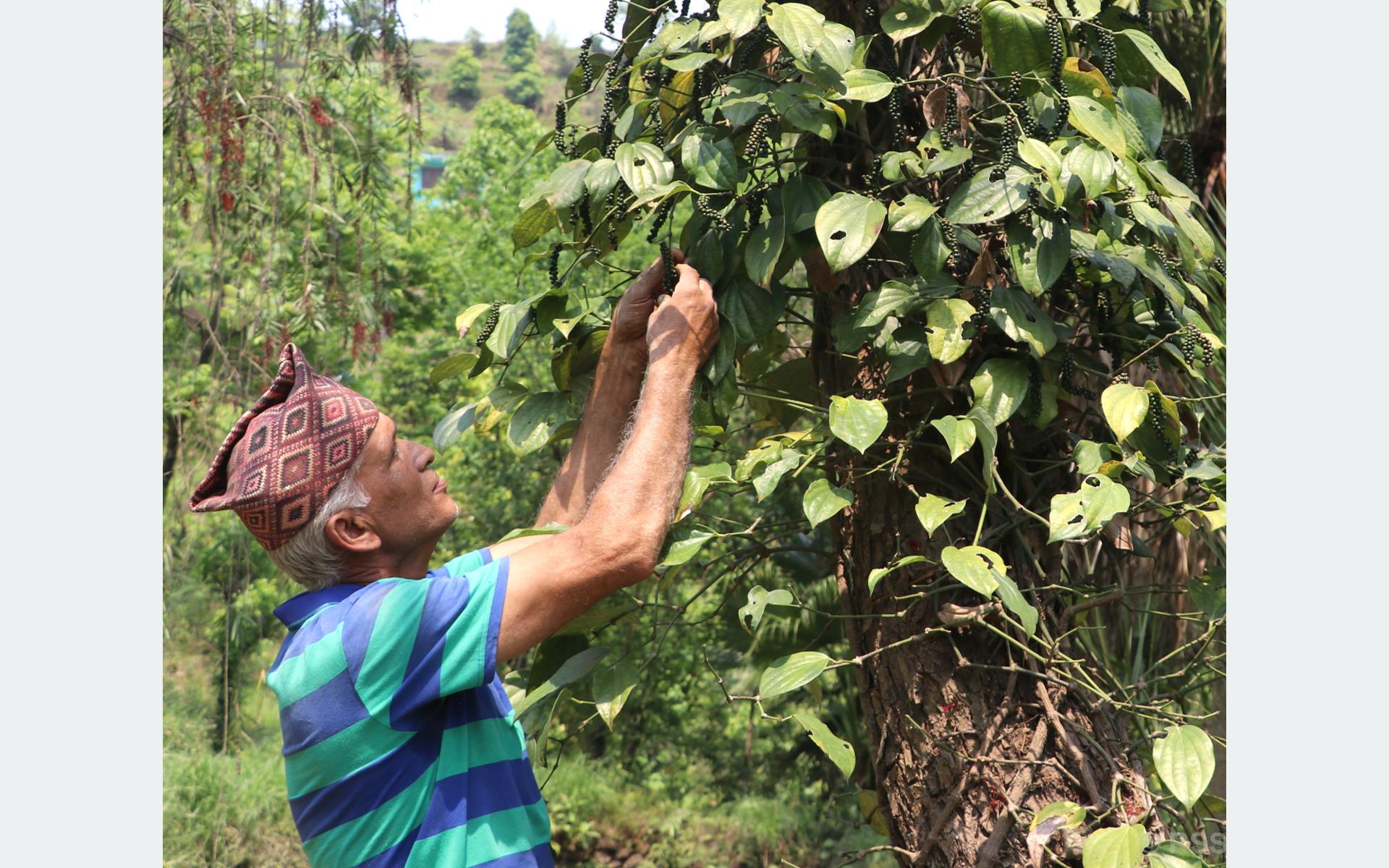
GANDAKI: A farmer in Pokhara has proven that with an understanding of agricultural potential and market demand, one doesn’t need to seek employment abroad.
Surya Mohan Bastola, a resident of Syangkhudi Tari in Pokhara Metropolitan City-28, has set an example by turning a barren hillside into a profitable black pepper farm.
Bastola has cultivated pepper plants beneath over 100 green trees—including sal, mango, and jack fruits, among others — that grow around his house. He is delighted that these plants are now fruiting regularly.
According to him, he earns between Rs 100,000 to Rs 300,000 annually from selling the harvested pepper.
Pepper—often referred to as “black gold” for its high value among spices—sells effortlessly in the market.
Bastola currently sells dried pepper for Rs 2,000 per kilogram. His pepper farming journey began in 2046 BS when he bought two seedlings for Rs 20 from Atraya Gurung of Bhandardhik, Lekhnath.
Though one plant died, the other flourished, and five years later, it began to bear fruit—eventually growing into a full-fledged business.
“In the early days, I didn’t know when or how to harvest or process the fruit, and a lot was wasted,” he recalls.
“But experience has taught me, and now it provides a steady income.” As he picks ripe pepper from the plants, he remarks, “Pepper farming has become my cash cow.”
Now 60 years old, Bastola has registered the Amrit Kunj Organic Permaculture Farm. He highlights pepper as a low-maintenance, pest-resistant cash crop that is unaffected by hailstorms or monkeys, and has become the foundation of his livelihood.
Rows of lush green pepper bushes stretching 20 to 30 meters can be seen across his farm. Pepper farming has not only generated income but also inspired Bastola to cultivate other commercial herbs and plants.
His permaculture farm, spread across about 30 ropanis, now hosts over 550 species of plants—including medicinal herbs, agarwood, red sandalwood, red bananas, and sitalchini. Even land once used for growing traditional rice has turned green with his diversified crops.
Notably, Bastola has maintained organic farming practices, relying entirely on compost without using chemical fertilizers or pesticides.
Despite this, he says he has received no government support and feels the authorities have yet to acknowledge his pesticide-free, organic model.
In addition to selling pepper, Bastola has also begun producing seedlings. This year, he has cultivated 2,000 seedlings and aims to earn over Rs 50,000 from their sale.
With demand rising, he sells each seedling for Rs 300. “This year alone, the Thuldhunga Community Forest Users Group in Puranchaur, Pokhara-19, ordered 300 pepper and pipal seedlings, while another 50 pepper seedlings were ordered from the east,” he shared. Seedlings are currently being sold directly from his home.
The growing demand has encouraged Bastola to target production of 10,000 seedlings next year.
His enthusiasm grew after Pokhara Metropolitan City Mayor Dhanraj Acharya visited his farm and announced the city’s intention to purchase his seedlings for distribution to other farmers.
Bastola explained his seed preparation process: ripe peppercorns are soaked in water for a day, mixed with cow dung, rubbed clean, and then planted in nursery beds.
They germinate within a month and are ready for transplanting after one and a half months. Pepper can also be propagated by grafting, budding, or cutting. Around Magh, branches with two to three nodes are cut and planted, requiring adequate shade and watering. Once the plant starts fruiting, it can yield a good harvest for up to 20 years, although productivity gradually decreases with time.
Bastola’s Amrit Kunj Organic Permaculture Farm in Syangkhudi Tari, Pokhara-28, has become more than just an income-generating venture. It has also emerged as an environmental model and a center of learning for international researchers.
Having started this initiative four decades ago, Bastola never needed to seek opportunities abroad. Instead, his farm has drawn visitors from across the globe.
Researchers and students from 15 countries—including Italy, China, the United States, Germany, Switzerland, Japan, Pakistan, India, Bangladesh, and Canada—have lived and worked on his farm, engaging in daily agricultural activities like digging, weeding, composting, and pepper harvesting, all while living like family members for periods ranging from 15 days to two months.
According to Manohar Kadariya, Chief of the Agriculture Division of Pokhara Metropolitan City, Bastola’s farm—located in the watershed of Begnas Lake—has been certified as a suitable environment for pepper cultivation.
Laherewali (climber) pepper is a key spice crop in Nepal, especially suited to hilly regions. Kadariya noted that the metropolitan city has begun efforts to promote pepper farming by supporting farmers financially and expanding its cultivation.
According to Surya Mohan Bastola, pepper—known as the “king of spices”—is a perennial, evergreen, and climbing crop. Because of its creeping stem, the plant requires a support structure to grow. Its botanical name is Piper nigrum, and it belongs to the Piperaceae family.
The primary active compound in pepper is piperine, which gives it its distinctive pungency. Typically, the pepper used in cooking is dried and processed, resulting in a product known as pipericon.
Believed to have originated in southern India, pepper is now cultivated in tropical regions across the globe. Major commercial producers include Vietnam, India, Brazil, Malaysia, Indonesia, China, and Sri Lanka.
According to current data, Vietnam is the world’s largest producer and exporter of pepper, accounting for about 34 percent of global output. In Nepal, pepper is cultivated in several districts including Morang, Sunsari, Jhapa, Ramechhap, and Lamjung.
Black pepper is widely used as a spice in various cuisines and also holds significance in traditional Ayurvedic medicine.
It is known for its properties that aid digestion, stimulate appetite, and help treat coughs, respiratory issues, and heart conditions. Additionally, it is used in dental products like toothpaste and tooth powder.
Among the most recognized varieties worldwide, Belankottha and Kotthandan are considered high-quality types, while Panniyur is a well-known hybrid. Pepper cultivation is also viable in community forest areas, offering additional agricultural potential.
This tropical crop thrives in warm, humid climates with high rainfall. It can be cultivated commercially in hilly regions with similar conditions.
Suitable for elevations up to 1,500 meters above sea level, pepper requires an annual rainfall of 2,000 to 3,000 mm. Data indicates that a relative humidity of 60 to 90 percent is ideal for optimal growth.






Comment