




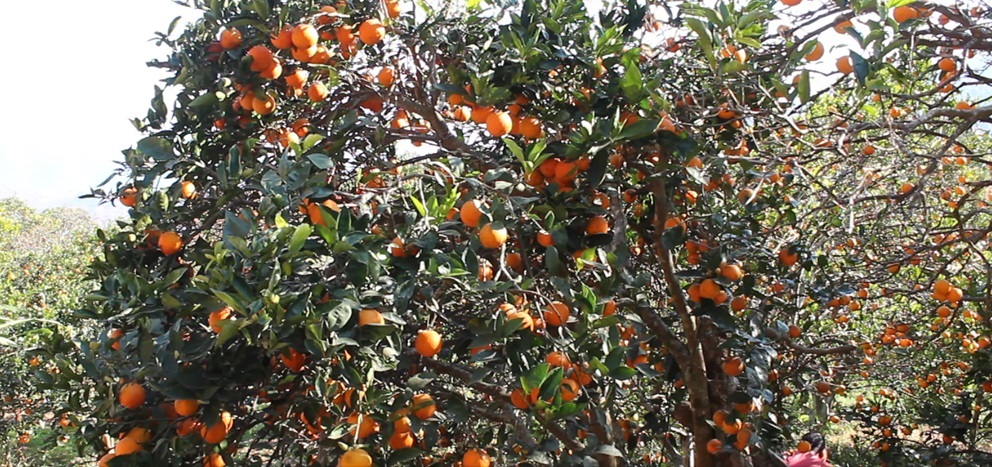
SINDHULI: Long before Sindhuli had a proper road network, local farmers were already producing up to 10,000 tonnes of junar (sweet orange) annually.
Yet, due to poor infrastructure and lack of market access, much of the harvest would rot in orchards, leaving farmers disheartened and their investments wasted.
Back then, without proper transport, farmers had to carry their harvests in doko (bamboo baskets) and walk for hours to reach Madhi Bazar, often managing to sell only a fraction of their produce.
The absence of cold storage and timely market access meant the rest of the fruit perished.
In 2063 BS (2006 AD), a cold storage facility was initiated in Dobhantar, Kamalamai-4, and began operations in 2067 BS (2010 AD).
However, it suffered heavy losses—about Rs 2.5 million in the first two years—due to lack of technical know-how, according to Deepak Koirala, Chairperson of the Junar Central Cooperative Union.
A turning point came in 2012 AD when Nepal and China signed an agreement to export Sindhuli’s junar to China. This led to improvements in storage, quality control, and packaging with support from China’s General Administration of Quality Supervision and Nepal’s Department of Agriculture.
To facilitate this, the Sindhuli Chamber of Commerce and Industry, along with FNCCI, began constructing a dedicated junar industry building.
Despite high hopes, problems soon surfaced. Although agreements were made to purchase 2,000 tonnes of junar at Rs 25 per kg from farmers, pest attacks on junar trees reduced output significantly, and the factory received only 200 tonnes.
The situation further deteriorated due to a critical flaw in the Nepal-China agreement, which required junar orchards—not just the fruits—to be completely disease and pest-free—an impossible standard, according to farmers.
Koirala noted that if the agreement had specified “disease- and pest-free fruit” instead of orchards, exports to China would have been viable.
As a result, Sindhuli’s junar production has plummeted from 10,000 tonnes to just 3,000 tonnes. Of the original 3,100 farmers, more than 2,000 have abandoned junar farming.
Both the cold storage facility, built with support from the Japanese Embassy, and the processing factory have remained idle for over a decade due to declining production, export bottlenecks, and institutional neglect.
The cold store alone cost Rs 13 million, with six million provided by the Japanese Embassy and the remainder funded by local government bodies and farmers.
Meanwhile, the Sindhuligadhi Junar and Fruit Processing Company, established with an investment of Rs 60 million under a public-private partnership (PPP) model, has stalled.
The facility, built on five katthas of land under FNCCI’s “One Village, One Product” initiative, was abandoned after FNCCI withdrew support and the government failed to provide the remaining Rs 20 million in funding.
The initiative, originally championed by former FNCCI president Suraj Kumar Baidya, has since been neglected by successive leadership. Though Baidya still leads the industry and is pushing to revive it, the lack of political and institutional will remains a major hurdle.
Arjun Kumar Kshetri, President of the Sindhuli Chamber of Commerce and Industry, said the internal disputes among the industry promoters are to blame for the prolonged closure.
He called on local, provincial, and federal governments to intervene and pledged the Chamber’s support for revival efforts.
Bagmati Province’s Minister for Industry, Commerce, Land, and Administration, Sukumaya Tamang, also expressed the provincial government’s willingness to support the factory’s reoperation.
“If revived, the factory could help secure a market for local junar and boost Sindhuli’s economic and industrial growth,” she said.
Junar farming in Nepal dates back to the Rana era. While initially limited to household consumption, it gained commercial status after the 1970s. During the Sixth Five-Year Plan, the government promoted junar cultivation, with Sindhuli and Ramechhap emerging as leading producers. In 2019 (2076 BS), Ramechhap was declared a “junar zone” under the Prime Minister’s Agriculture Modernisation Project. Today, junar is cultivated in 49 districts, with Sindhuli and Ramechhap continuing to lead.
Despite the sector’s early promise, the stagnation of infrastructure and failed policies have left Sindhuli’s farmers stuck in a long wait—for revival, and for justice.






Comment