




It was a lazy Sunday morning—one of those slow, unhurried starts after a long week. I was still tucked in bed, scrolling mindlessly through Instagram when a reel caught my full attention.
In the reel, a conversation played out between two characters—a guy and a girl.
The guy looked at her and said bluntly, “I’m sure you are a virgin!” It wasn’t a question. It was a statement—loaded and intrusive. And something about the tone, the confidence, and the assumption behind it… it hit me.
I wasn’t even in the reel, but I felt uncomfortable. Like I was expected to answer too. Like someone had pointed that question at me, with or without my consent.
A Personal Moment
I sat with that discomfort for a while. Later that day, I shared the incident with one of my closest male friends. Half-joking, I said, “Who even stays a virgin after 18 these days?” He smiled quietly, paused, and replied, “I do.”
His answer was calm, sincere, and unapologetic. But why did even talking about it feel so heavy? Why did something so personal carry such public weight?
Virginity: A Social Construct Dressed as Morality
Virginity—by definition—is simply the state of someone who has never engaged in sexual intercourse. But socially? It’s treated like a symbol. A badge. A burden. Tied to ideas of honor, purity, respectability—and too often, shame.
You can lose your virginity out of love, or during a mistake. You can also “lose” it doing gymnastics or riding a bike—because guess what? Virginity isn’t always physical. And it certainly isn’t a moral scorecard.
Growing up, especially in school, the word “virginity” felt like a dirty little secret. It was whispered in corridors. Used as a joke, a slur, a rumor. Sex education came wrapped in silence—teachers avoided eye contact, we giggled nervously, nobody really talked.
But why? Why is something so natural, so human, wrapped in so much embarrassment? Why is virginity still treated as a badge of pride for women—but a non-issue (or even a joke) for men? Why is curiosity okay for boys but judged in girls?
A Conversation That Changed Me
A few days ago, I met an old high school friend—someone I hadn’t seen in years. She’s now a practicing lawyer, bold and brilliant in every way. Over coffee, we talked about the usual: careers, catching up on old classmates, future plans. Naturally, the topic drifted toward relationships and marriage.
I asked her, playfully, “So, when are you getting married?” She laughed, brushed it off casually, but I nudged a little—half-joking, half-curious. That’s when her smile faded just a bit, and her tone shifted.
She leaned in and said, “You know, something strange happened recently.” Her parents had arranged a meeting with a potential groom from a well-off business family. Everything on paper sounded great—decent guy, good background, respectful demeanor.
They met briefly at a family gathering and later exchanged numbers. The conversations started off polite, if not a little formal. Then, one evening, during a late-night phone call when the small talk had worn off, he asked her—without warning, without hesitation: “Are you still a virgin?”
She went silent for a moment, stunned—not just by the question, but by how casually and confidently he asked it. No context. No sensitivity. Just a straight-up intrusion into her most private space.
But she didn’t flinch. Instead, she bravely asked him back: “Are you?”
He scoffed. “I’m a man. Why does that matter?”
And just like that, the conversation ended. Not just the phone call, but the whole possibility of a relationship. She blocked his number and told her parents she wasn’t interested.
I sat across from her in silence, both impressed and disturbed. Impressed by her courage to walk away—disturbed by what that question revealed.
It made me wonder: What exactly was that guy taught growing up? Did someone ever tell him that a woman’s virginity is a measure of her worth? That her value could be reduced to a single word, a single “yes” or “no”? That it’s okay—normal even—for him to ask, but not to be asked?
Where did he learn that his actions, his past, his choices were irrelevant—but hers were up for interrogation?
The deeper I thought, the clearer it became: he is not alone. That question was not born from his own curiosity alone. It was baked into him—through culture, media, family whispers, religious fear, and social norms that pretend to be moral compasses.
Because society has long operated on this unspoken rule: A man’s experience is freedom. A woman’s experience is shame. And virginity? It has been twisted into currency. Not about health. Not about choice. Not about love. But about control.
It’s often paraded like a virtue in women—yet dismissed or even mocked in men.
It’s used as a test, as if someone’s entire character, past, and future can be determined by a yes or no answer to a question that no one has the right to ask in the first place.
Why does this still happen? Why is virginity anyone’s business but your own? It’s not a checklist for marriage. It’s not a purity test. It’s not a family heirloom to be guarded until someone deems it worthy to be “lost.”
It is personal. It is private. And it does not belong to parents, relatives, in-laws, society, or strangers who think they’re entitled to know.
Virginity is not a virtue. Losing it is not a crime. Talking about it is not shameful. It’s time we take back the power this word has been given to judge, divide, and control. Because at the end of the day, virginity is just one part of being human. And being human is never something to be ashamed of.
So when she told me she walked away, I wasn’t just glad—I was proud. Because sometimes walking away from one man means walking away from centuries of oppression stitched into polite questions.
Let’s Be Honest: Virginity is not purity. It’s not character.
You can lose your virginity out of love, or during a mistake. You can also “lose” it doing gymnastics or riding a bike—because guess what? Virginity isn’t always physical. And it certainly isn’t a moral scorecard.
It does not define your dignity. It does not define your future. It does not define your worth. What it does reveal is how far we still need to go in creating open, honest spaces—especially in homes and schools.
Why should young people grow up whispering words that describe basic human experience? Why should they learn about sex, consent, and relationships through gossip or internet myths?
We claim we’re modern. Progressive. But most of us still freeze when someone says the word sex in a room full of adults.
Change Starts at Home
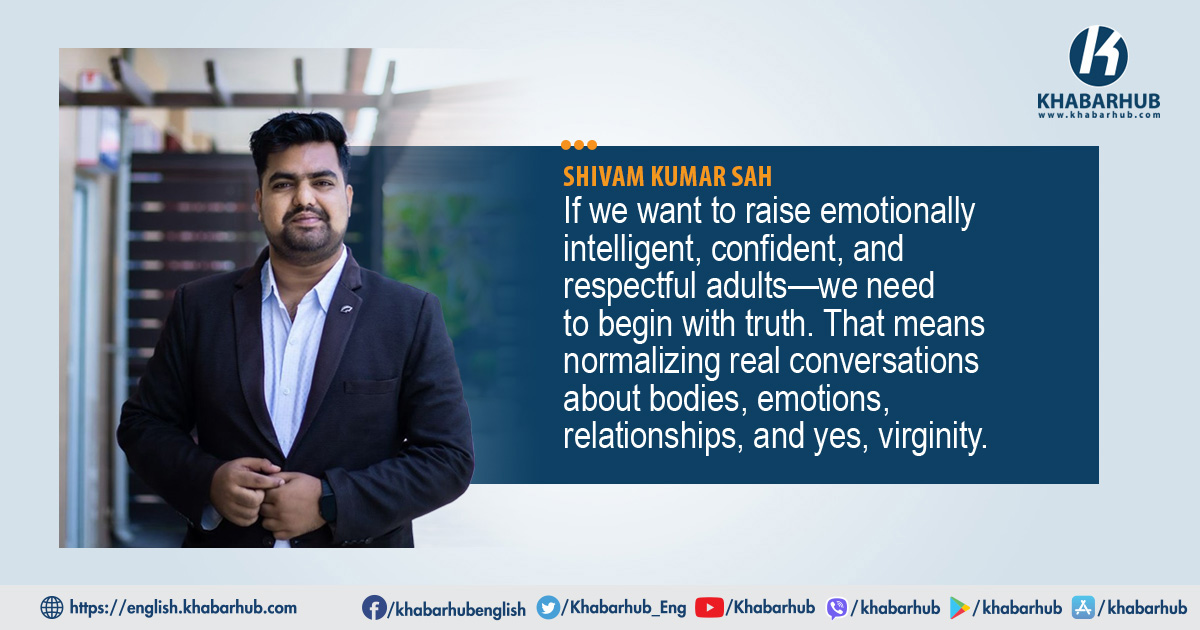
This silence breeds shame. And shame breeds fear, judgment, and misinformation. If we want to raise emotionally intelligent, confident, and respectful adults—we need to begin with truth. That means normalizing real conversations about bodies, emotions, relationships, and yes, virginity.
Let’s teach our children that their bodies are theirs—not society’s to label or control.
Let’s teach boys that respect is strength. Let’s teach girls that their worth is not between their legs. And let’s teach everyone that what two consenting adults do in private is nobody else’s business.
Final Thought
Virginity is not a virtue. Losing it is not a crime. Talking about it is not shameful. It’s time we take back the power this word has been given to judge, divide, and control. Because at the end of the day, virginity is just one part of being human. And being human is never something to be ashamed of.
(Views expressed in this opinion are the writer’s and do not necessarily reflect the editorial stance of Khabarhub)






Comment