




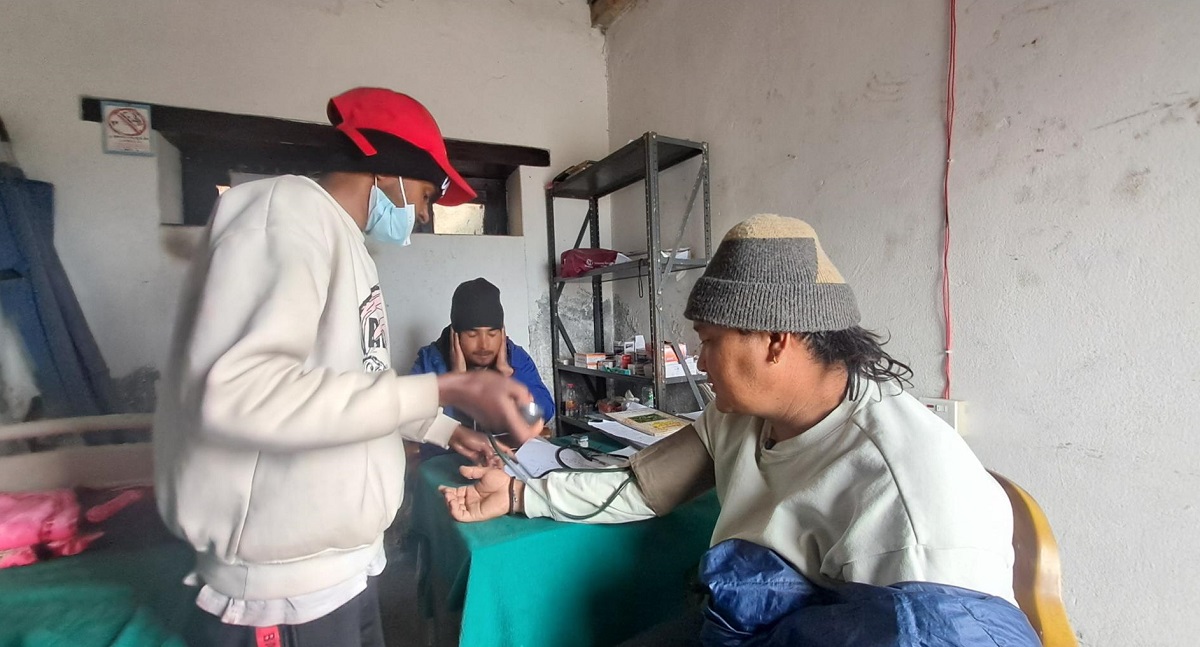
MUSTANG: Free health care services have been arranged for pilgrims suffering from altitude sickness at Muktinath Temple, a revered pilgrimage site for both Hindus and Buddhists.
The initiative is a joint effort by the Provincial Hospital in Jomsom and the Waragung Muktikshetra Rural Municipality, aimed at assisting religious tourists who fall ill due to high altitude.
Located at an elevation of around 3,800 meters above sea level, Muktinath often sees pilgrims affected by altitude sickness.
To address this, a ‘High Altitude Treatment Center’ has been established within the temple premises, providing emergency care to those in need.
Health Coordinator Khagendra Bohara of the rural municipality said the center was created to offer immediate medical assistance to affected pilgrims.
The Provincial Hospital has provided medical personnel and oxygen supplies, while the rural municipality is supporting logistics and medicines.
Two health assistants have been deployed on contract to staff the center round-the-clock. The treatment facility is equipped with three beds and three oxygen cylinders.
Of these, two beds and two oxygen units are stationed slightly away from the temple, while one bed and one cylinder are placed within the temple premises for immediate response.
Health Assistant Saroj Gharti Magar said that since the center’s establishment, more than 2,000 people have received services, including 179 cases in the Nepali month of Chaitra alone.
However, he noted that the center’s current infrastructure is inadequate. “The room is small and overcrowded during emergencies. A proper facility with sufficient space and infrastructure is urgently needed near the temple premises,” Gharti Magar said.
Patients requiring advanced treatment are referred to the Provincial Hospital in Jomsom. Health Assistant Bikash Thakur shared that elderly pilgrims between the ages of 45 and 94 have already received treatment at the center.
Pilgrims arriving in Muktinath from lower altitudes without taking time to acclimate are at high risk of altitude sickness.
This risk is especially pronounced among elderly individuals and those with pre-existing health conditions.
Indian tourists arriving directly from low-altitude regions are frequently affected, often suffering from heatstroke rather than altitude sickness, especially after bathing under the 108 taps on an empty stomach or dipping into the cold water tanks.




Comment