




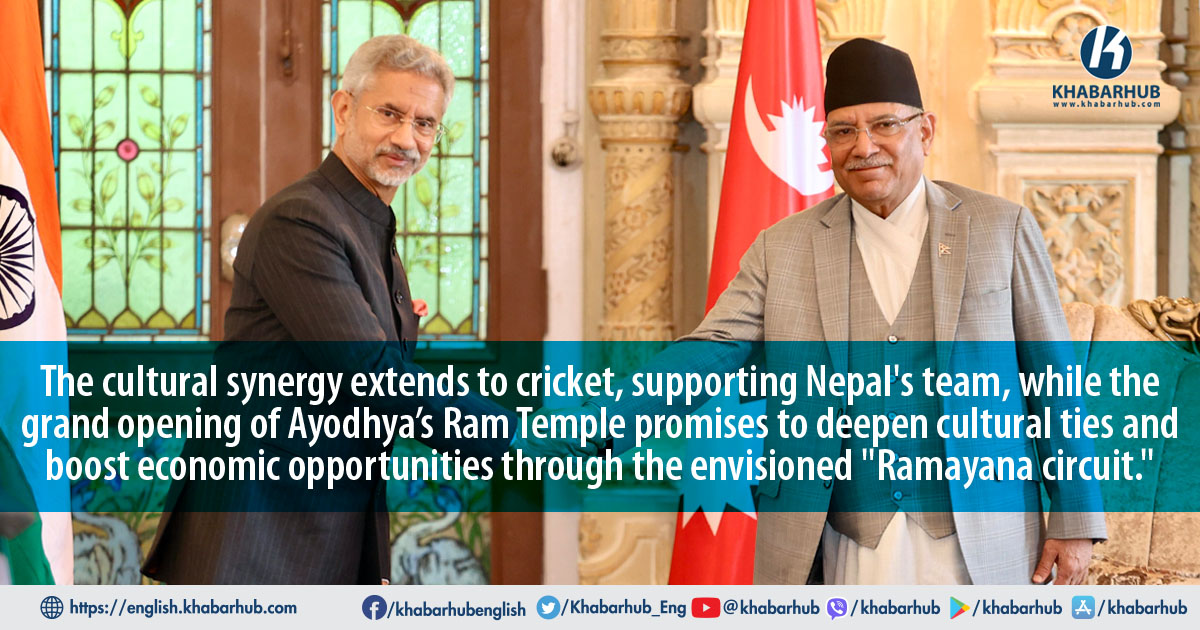
A two-day visit by India’s External Affairs Minister (EAM), Dr. S Jaishankar, to Nepal in early January 2024 proved remarkably fruitful for the bilateral relationship.
Co-chairing the 7th India-Nepal Joint Commission meeting alongside Nepal’s Foreign Minister N P Saud, the visit yielded two significant agreements: a long-term power trade pact and a commitment to boosting investment in impactful community development projects.
Stretching along a 1,850-kilometer border, Nepal and India share a profound connection rooted in their joint independence from British rule.
The enduring bond is formalized by the 1950 Treaty of Peace and Friendship, resulting in open borders, seamless commerce, and deep cultural ties.
Visa-free movement grants Nepalese and Indian citizens nearly equal rights in each other’s countries, fostering a familial connection seen in language, dress, and cuisine, especially among residents of Nepal’s Terai region and neighbouring Indian states.
This interconnectedness goes beyond daily life, involving robust collaboration in energy, defence, trade, and cultural exchange.
Termed as “Roti Beti ka Rishta” in Hindi, representing the deep bond of bread and daughters, this relationship signifies mutual support and shared prosperity.
For decades, India has been a cornerstone in Nepal’s development journey. Through generous grants and Lines of Credit, India has invested directly in building crucial infrastructure, particularly in the Terai region along their shared border.
Integrated Border Check Posts, constructed by India, streamline the movement of people and goods between the two nations.
The Cricket Association of Nepal officials had asked for India’s assistance for the construction of a stadium. In response, Jaishankar offered the Nepali cricket team the use of an Indian stadium as their official “home ground.”
As Nepal’s top trading partner, India plays a vital role in its economy.
While the trade balance currently favours India, it has actively encouraged Nepal’s self-sufficiency by supporting the development of production facilities and attracting foreign investment (with India itself being the largest investor).
This long-standing partnership aims not only to foster Nepal’s growth but also to gradually create a more balanced economic relationship between the two neighbours.
The power agreement represents a significant milestone during the visit of the Indian External Affairs Minister, formalizing an understanding to export 10,000 megawatts of electricity from Nepal to India over the next decade.
This development paves the way for deeper collaboration in the sector, with Indian public sector units actively participating in the development of hydropower projects in Nepal.
The signing of a Memorandum of Understanding on renewable energy development between the Nepal Electricity Authority and NTPC Limited further underscores the shared commitment to clean energy solutions.
In a display of strong bilateral ties, the two Ministers jointly inaugurated three crucial 132 kV power lines: a second circuit on the Raxaul-Parwanipur line, another second circuit on the Kataiya-Kusaha line, and the brand new Nautanwa-Mainhiya line.
These lines will boost cross-border energy transmission between India and Nepal by a significant 200 MW, bringing the total capacity to an impressive 1,400 MW.
Beyond energy, the visit also witnessed the launch of a Service Agreement for the Munal Satellite, developed by Nepal Academy of Science and Technology in collaboration with NewSpace India Limited.
This collaboration bodes well for future advancements in space technology and research.
The Indian government, through the Foreign Minister, handed over the fifth instalment of aid for victims of the Jajarkot earthquake.
This tranche included 20 prefabricated houses, alongside blankets, tents, and sleeping bags. The remaining 180 houses will be delivered in stages over the coming weeks.
To further bolster Nepal’s post-earthquake recovery, the Foreign Minister also announced a substantial financial assistance package of approximately NPR 1000 crores, primarily in the form of grants.
India’s EAM, Dr Jaishankar. observed that guided by the principles of ‘Sabka Saath, Sabka Vikas, Sabka Vishwas, Sabka Prayas,’ (Everyone’s support, everyone’s development, everyone’s trust with concerted efforts). India is determined to progress on its development journey, extending a hand of partnership to trusted neighbours, including Nepal.
This commitment, he emphasized, stems from the leadership of Prime Minister Modi’s vision for a redefined regional relationship built on collaboration and mutual progress. As a cornerstone of India’s “Neighbourhood First” initiative, Nepal enjoys a position of paramount importance.
In this context, EAM recalled that Prime Minister Modi during his visit to Nepal in 2014 proposed the “HIT” framework (Highways, Information ways, and Trans-ways) to guide India-Nepal relations.
India’s “Neighbourhood First” policy is a cornerstone of its foreign relations, prioritizing the development of strong and cooperative ties with its immediate neighbours.
Launched in 2014, the policy aims to foster peace, stability and shared prosperity in the region.
The key elements of the policy consist of recognizing the unique identities and interests of each neighbour (Samman), engaging in regular and open communication at all levels (Samvad), promoting regional security and cooperation on issues like terrorism and counter-narcotics (Shanti), supporting economic development through trade, investment, and infrastructure projects (Samriddhi) and finally, celebrating the rich cultural heritage shared by India and its neighbours (Sanskriti).
Dr Jaishankar further strengthened diplomatic ties through courtesy visits to Nepal’s President and Prime Minister, followed by meetings with key political figures like Sher Bahadur Deuba and K P Sharma Oli.
The Ramayana circuit is one of only two transnational circuits promoted by India’s Ministry of Tourism, reflecting the immense importance placed on cultural ties with Nepal.
He also interacted with the Nepali national cricket team, highlighting the importance of cultural and sporting exchange in fostering closer bonds between the two nations.
The Cricket Association of Nepal officials had asked for India’s assistance for the construction of a stadium. In response, Jaishankar offered the Nepali cricket team the use of an Indian stadium as their official “home ground.”
This heartwarming announcement was greeted with great joy by Nepal Cricket Team captain Rohit Paudel, who hailed it as a game-changer.
While Nepalese cricketers have already been valiantly competing on the international stage, this generous backing from India promises a significant boost, paving the way for a brighter future for the sport in Nepal.
With the grand Ram Temple in Ayodhya set to open shortly, Nepal is buzzing with anticipation for the potential tourism surge it might bring.
Janakpur, believed to be the birthplace of Lord Ram’s consort Sita, hopes to attract pilgrims visiting Ayodhya, creating a “Ramayana circuit” spanning both countries.
Nepal’s Ambassador to India, Shankar Prasad Sharma, in December 2023 emphasized the deep cultural ties between India and Nepal, highlighting Janakpur’s importance as part of the Ramayana circuit. He envisions improved road and rail connectivity fostering economic development throughout the region.
Janaki Mandir, Sita’s purported birthplace, stands as a powerful symbol of Nepal’s cultural heritage and a key element in strengthening India-Nepal relations.
Sharma believes the Ramayana circuit can attract not only Indian pilgrims but also tourists from Thailand, Indonesia, and beyond, who share an interest in the epic story.
Nepal further boasts a Balmiki ashram, believed to be where Sita spent months in religious retreat. This underscores the deep-rooted love for the Ramayana and its ideals within Nepal.
The cultural synergy extends to cricket, supporting Nepal’s team, while the grand opening of Ayodhya’s Ram Temple promises to deepen cultural ties and boost economic opportunities through the envisioned “Ramayana circuit.” The visit underscores enduring collaboration, diplomatic ties, mutual growth, and shared prosperity.
Both countries actively support the circuit’s development, with India having granted Rs 100 crore for Janakpur’s development and a bus service connecting it to Ayodhya.
The Ramayana circuit is one of only two transnational circuits promoted by India’s Ministry of Tourism, reflecting the immense importance placed on cultural ties with Nepal.
This initiative is also seen as a way to counter China’s growing economic influence in the region. With India and Nepal joining hands to promote this cultural treasure, the Rashtriya Swayamsevak Sangh (RSS) emphasizes the deeper bond that transcends governments and borders.
Ambassador Sharma observed that the Ramayana circuit will impact not only South Asian countries but the entire world.
The inauguration of the Ram Temple marks a significant moment, not just for Ayodhya and India, but for Nepal as well.
The potential tourism boom promises to strengthen cultural ties, boost economic development, and bring the world closer to the timeless beauty of the Ramayana.
In conclusion, Dr. S Jaishankar’s two-day visit to Nepal in January 2024 marked significant progress in bilateral ties. Co-chairing the 7th India-Nepal Joint Commission meeting, the visit resulted in crucial agreements—a long-term power trade pact and increased investment in community projects. Rooted in shared history and formalized by the 1950 Treaty of Peace and Friendship, the nations’ connection encompasses open borders, seamless commerce, and cultural bonds.
The power agreement, enabling the export of 10,000 MW of electricity from Nepal to India, symbolizes deep collaboration. Inaugurating power lines, launching the Munal Satellite Service Agreement, and aiding earthquake victims showcase shared advancements and humanitarian commitment.
The cultural synergy extends to cricket, supporting Nepal’s team, while the grand opening of Ayodhya’s Ram Temple promises to deepen cultural ties and boost economic opportunities through the envisioned “Ramayana circuit.” The visit underscores enduring collaboration, diplomatic ties, mutual growth, and shared prosperity.
(Author Dr Maheep is an eminent scholar in the field of India’s Foreign Affairs and Global Politics. He contributes regularly on critical issues)




Comment