




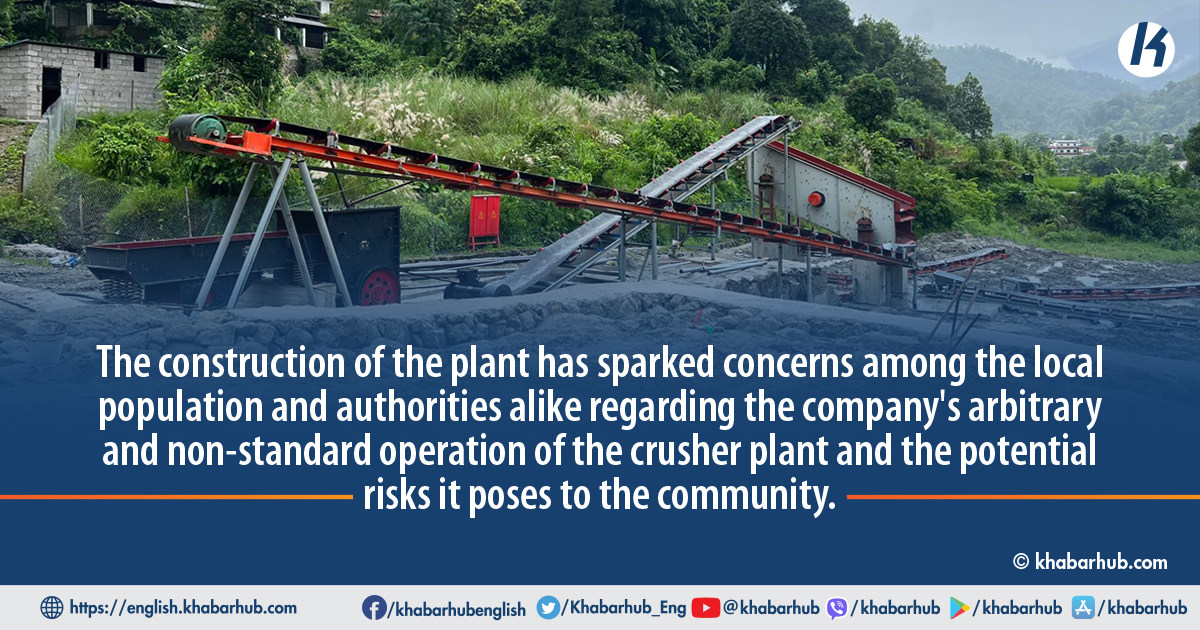
PALPA: The China State Construction Engineering Corporation’s approach to operating a crusher plant in Dhap within Tinau Rural Municipality-3 has raised serious concerns regarding compliance with industry standards and local safety.
Despite achieving 95 percent completion of the necessary physical structures for the industry, the company plans to operate the plant without adhering to minimum operational standards.
The company is poised to commence operations at a crusher plant located in Dhap of Tinau Rural Municipality-3 Dobhan of Palpa as part of the Siddhababa Surungmarg (Tunnel) Project.
It has not conducted an Initial Environmental Test (IEE) or an Environmental Impact Assessment (EIA) for the plant’s operation, and it appears to have disregarded the regulations pertaining to distance requirements.
The plant is situated a mere 50 meters from the Siddharth highway, and it is also within 100 meters of the Tinau river and a concrete bridge.
In addition, there is a settlement only 20 meters from the plant, with the municipality center being located 200 meters away.
It may be noted that, for the operation of such a plant, a minimum distance of 500 meters from highways, water bodies, riverbanks, and concrete bridges is typically mandated by regulations.
The company’s lack of adherence to these standards is not the only issue; local authorities also seem to be unaware of the required distances.
In cases like this, it is customary to engage with the citizens of the affected areas, seeking their opinions, suggestions, and conducting discussions, but such efforts have been conspicuously absent in this instance.
This has sparked concerns among the local population and authorities alike regarding the company’s arbitrary and non-standard operation of the crusher plant and the potential risks it poses to the community.
Local resident Bishnu Prasad Pandey expressed concern about the industry’s approach, stating that they plan to operate it in a heavy-handed manner without engaging in a proper dialogue with the community.
Pandey emphasized, “The industry hasn’t adhered to basic standards, such as conducting an Initial Environmental Examination (IEE) or complying with distance requirements.”
He further highlighted the absence of consultation with local residents.
Pandey stressed that these illegal industrial operations would significantly impact the community, stating, “By forcibly establishing the plant without considering people’s right to live in a clean environment, we cannot allow it to operate under any circumstances.”
Local residents took action by sending a letter to Tinau Rural Municipality and the industry company on August 22, urging them to halt the construction of the crusher industry.
They expressed concerns about the potential need to relocate due to the illegal industry’s presence.
However, the industry proceeded with its preparations for plant operation, ignoring these requests.
Rural municipality Chairman Prem Shrestha explained that despite repeated requests from the municipality for documentation, the company has failed to comply.
Gyawali explained, “Given the community’s concerns about noise and environmental pollution, we instructed our construction professionals to adhere to the IEE to mitigate these issues.”
He stated, “Although we asked the company to provide evidence after receiving the locals’ request, they have only produced an approved letter from the Ministry of Physical Infrastructure.”
Chairman Shrestha mentioned that an all-party meeting was held to address the plant issue.
He stated, “Since the industry has completed 95 percent of its infrastructure work, we have reached an agreement to allow them to operate temporarily. If any adverse effects arise, we will initiate appropriate actions, as agreed during the all-party meeting.”
Shrestha assured that they would immediately halt any operation causing harm to the community.
Engineer Sabita Gyawali from the Siddha Baba Tunnel Planning Office defended the company’s actions, asserting that they had obtained approval for the Initial Environmental Examination (IEE) before commencing the project.
Gyawali argued that, as the crusher plant falls under the national pride project, it is exempt from some IEE and standard compliance requirements, unlike typical commercial crusher industries.
Chairman Shrestha pointed out that, despite IEE approval by the ministry before the project’s commencement, the document provided to the local government did not mention IEE anywhere.
Engineer Gyawali clarified that they moved forward with the project to address concerns raised by locals.
Gyawali explained, “Given the community’s concerns about noise and environmental pollution, we instructed our construction professionals to adhere to the IEE to mitigate these issues.”
While there is an agreement for a 15-day trial period, local residents have claimed that they are not aware of any such agreement.
The company’s objective is to establish a crusher plant to utilize materials extracted from the tunnel.
Engineer Gyawali affirmed that the plant’s operation is intended to make use of local resources.





Comment