



Talking about Nepal’s foreign policy, I find several aspects, including the current constitution and prevailing trends, somewhat unsatisfactory.
Firstly, there’s the concept of non-attachment. I question its relevance when we talk about Warsaw Pact and NATO. Who are the opposing poles in this scenario?
Should we be non-aligned? Does it imply that we won’t commit military support when needed?
Foreign Minister NP Saud recently mentioned our independence, emphasizing that it’s not solely about military commitment. But can we truly claim that independence? This discrepancy needs clarification.
What particularly concerns me is the socialist orientation embedded in the constitution.
It explicitly states our inclination towards socialism. However, in a democratic constitution, should such a preference be declared? Can a constitution take sides in ideological disputes?
This narrative of nationalism also seems to influence our foreign policy decisions, creating a complex interplay between these three elements.
Political parties should have the freedom to campaign on their agendas, but once the constitution mandates socialism, does it truly reflect democracy? This is a substantial question.
Now that we lean towards socialism, should individuals be compelled to conform to this ideology?
My concern stems from a televised debate on the MCC, during which a Nepali scholar stated, ‘Our constitution is oriented towards socialism,’ implying that we should avoid strategic cooperation with the capitalist America.
If our constitution tilts in that direction, should our foreign policy follow suit, possibly aligning more with socialist nations? These are uncertainties I grapple with.
Another facet is nationalism, which is enshrined in the constitution. However, it appears to be waning as we observe the sale of our resources, like the Kosi, Gandaki, and Mahakali rivers.
Recently, the MCC deal was added to the mix, but the details remain unclear. The Belt and Road Initiative (BRI) raises further questions. Are we maintaining a balanced approach with China?
This narrative of nationalism also seems to influence our foreign policy decisions, creating a complex interplay between these three elements.
I was deeply impressed by a statement made by Prime Minister Narendra Modi shortly after assuming office, where he declared, ‘I won’t lower my gaze, nor will I look up in submission. I will engage in direct eye contact.’
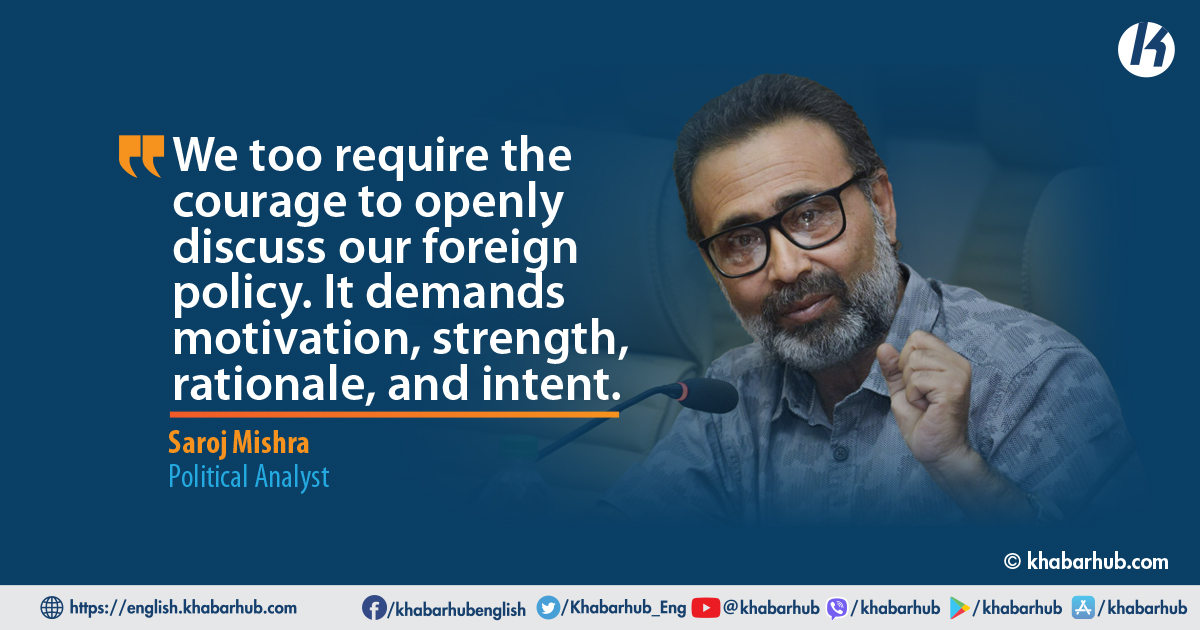
We too require the courage to openly discuss our foreign policy. It demands motivation, strength, rationale, and intent.
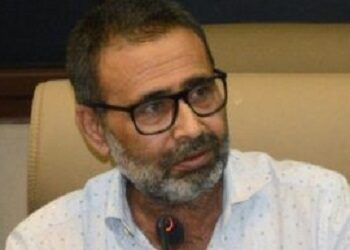
(An edited portion of the insights shared by political analyst Saroj Mishra during an interactive session on ‘Possibilities and Challenges of Nepal’s Foreign Policy,’at the Pavilion Hall, Durbar Marg, Kathmandu)




Comment