




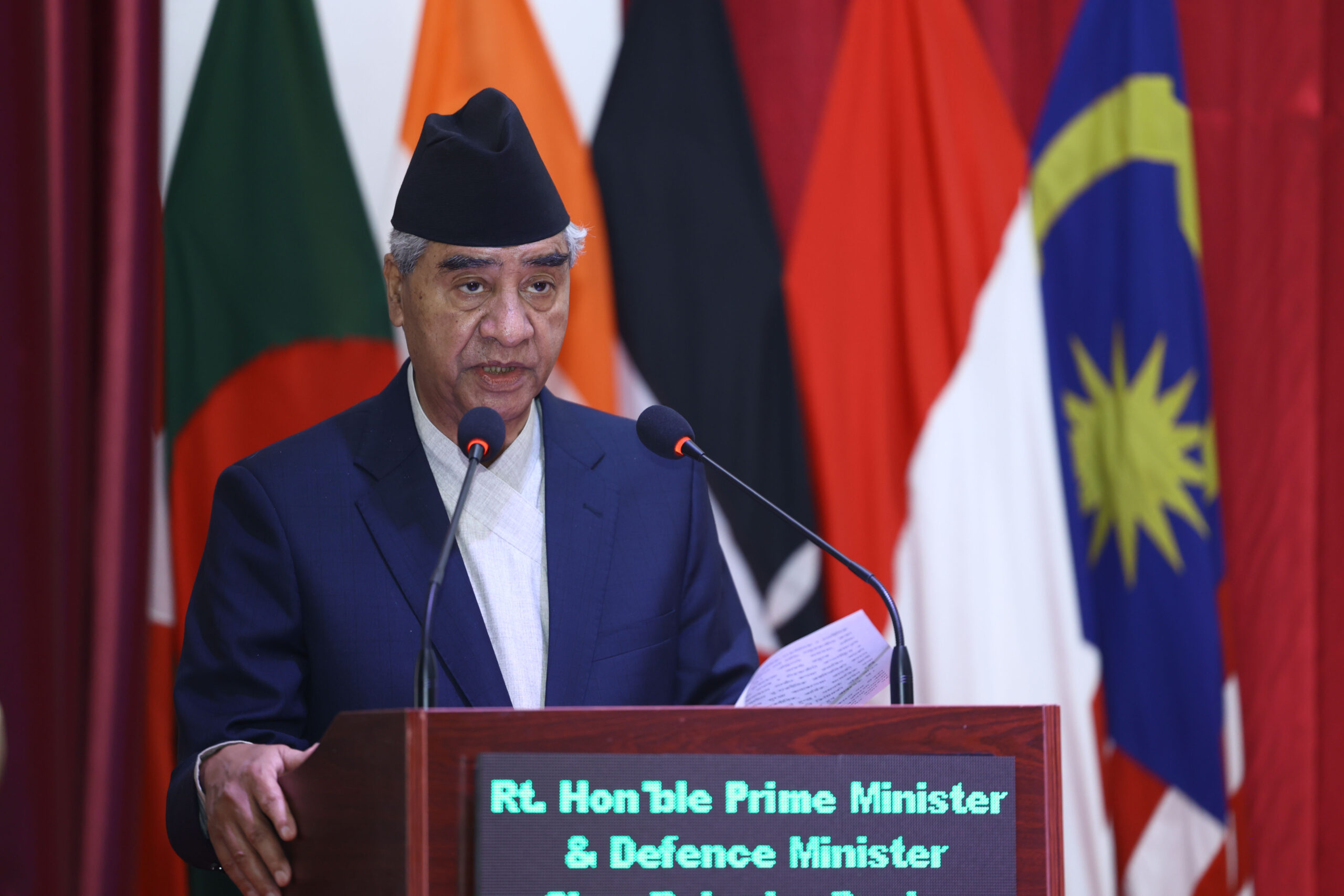
KATHMANDU: Prime Minister Sher Bahadur Deuba has said tension and competition surfaced lately among powerful nations to assert dominance in several forums have serious impacts on the fronts of international and regional security.
Addressing a concluding ceremony of the seventh group of Advanced Course on National Security organzied by Nepali Army Command and Staff College, Shivapuri, today (Friday), Prime Minister Deuba highlighted that there was a strong competition among powerful countries in the economic, political, and strategic sectors to establish their supremacy in today’s international scenario.
He shared, “A small change in international and regional security environment due to sensitive geo-political situation of the country will have implications in our political, economic, social and overall security sector. It is necessary that all should be alert and committed to keeping the country’s interest and welfare intact.”
Saying the government has brought policy and action plan, including national security policy and resilience policy, to strengthen this sector, PM Deuba opined, “National security is a sensitive and challenging issue. Strong coordination and collaboration among related bodies are necessary to enhance the level of national security.”
It is necessary to inform civil servants working in public bodies about the internal and foreign security challenges and possible measures for the resolution through training and orientation, he said, adding all bodies should always stay aware and alert to face security challenges through integrated efforts.
On the occasion, Chief of Army Staff (CoAS) Prabhuram Sharma said all-political, diplomatic, and educational circles, including the mass, had an equal role to play for proper management of emerging multidimensional security threats. He said, “Climate change and COVID-19 pandemic have further exposed whole security challenges, including the challenges for human security to the world.”
National security as a sensitive and profound issue is the concern and responsibility of all, according to the CoAS.
The CoAS further stated, “The scope of security is widening more, and in this context, citizens and all security mechanisms should have a common understanding on the matter of national security.”
Moreover, College Commandant and NA Major General Hiralal Joshi said the 14-day course aimed to develop a collective approach on the issues of national security and defense among the authorities concerned, and so far, 138 participants from the military force and from the civic circle attended it.
This time, 28 participants, including five journalists from national media, attended the training.






Comment