




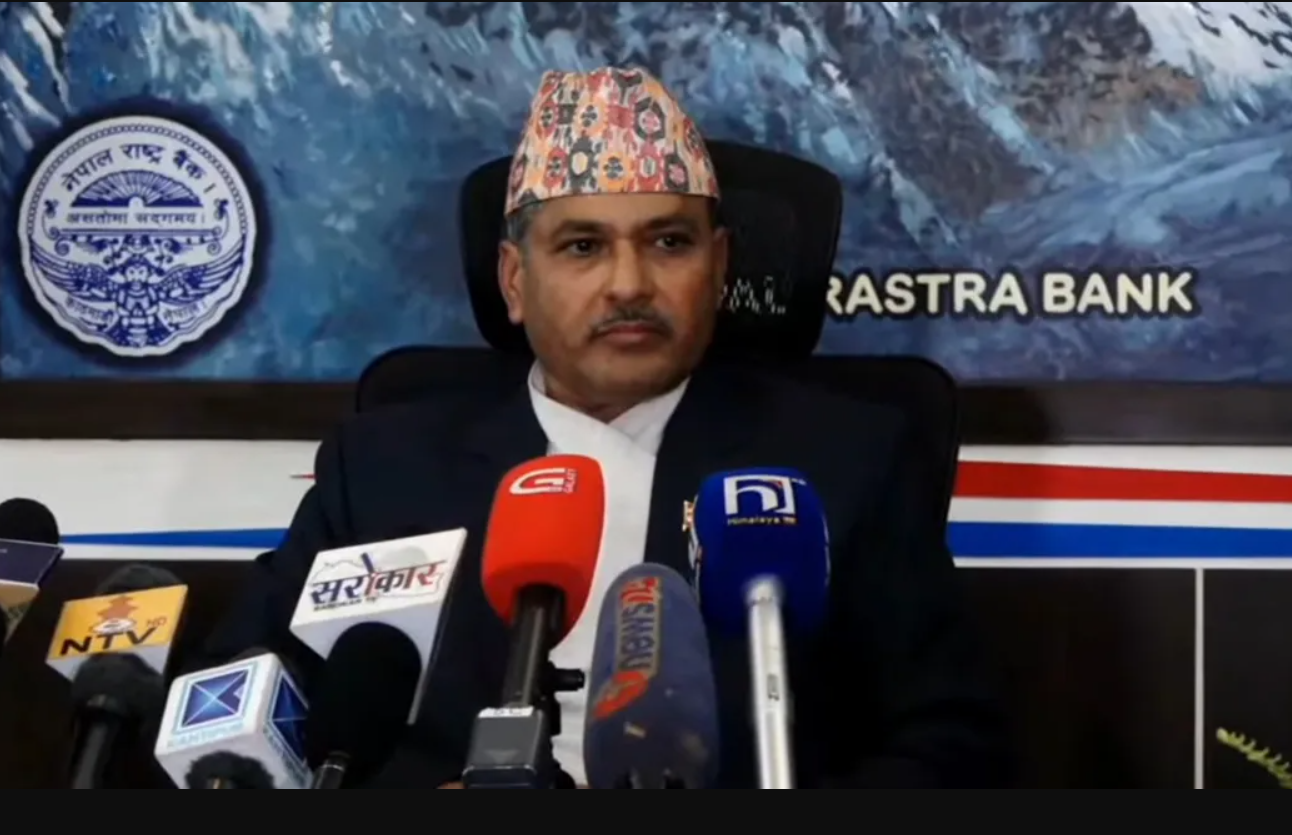
KATHMANDU: Nepal Rastra Bank Governor Maha Prasad Adhikari unveiled the much-awaited monetary policy for the fiscal year 2022/23 at 4 pm on Friday through Nepal TV live telecast.
According to Governor Adhikari, the new monetary policy aims to strike a compromise between the need for monetary tightness to uphold financial and economic stability.
The Central Bank may adopt a tight Monetary Policy to slow down overheated economic growth, limit spending in an economy that is seen to be accelerating too quickly, or curb inflation when it is rising too fast.
The government is tightening monetary policy this fiscal due to the slowing economy and the high inflation rate.
Fiscal projection for 2022/23
NRB has reduced the loan target. The Central Bank has lowered the credit expansion target of 19 percent to 12.6 percent.
Cash Reserve Ratio (CRR) has been increased from present 3% to 4% to be implemented from mid-August.
Commercial banks should increase the statutory liquidity to 12 percent, while development banks and finance companies should increase it to 10 percent by mid-January 2023.
Concessions and exemptions will be given to banks and micro-finance only if they conduct integrated business by mid-January next year.
The Risk Weight asset for a loan below Rs 2.5 million or its equal is 100% and for a Share loan above Rs 2.5 million is considered 150%.
The Central Bank has increased the bank rate from 7 percent to 8.5 percent. This change will increase the rate of transactions between banks. Whereas, policy rate is 7% and deposit collection rate is fixed 5.5%.
The interbank lending weightage average rate can be maximum within 2% range of the policy rate which is 7%.
The existing regulations issued by the Central Bank regarding the suspension of securities transactions during mergers and acquisitions of banks and financial institutions have been canceled. Now it has been arranged to be in accordance with the regulations of the Securities Board of Nepal.
NRB has made general changes in share mortgage loans. The government has made general revisions to the limit of 4/12 previously fixed for share mortgage loans, and only Rs 120 million have been fixed.
In other words, previously, if a loan of Rs 40 million was obtained from one organization and a maximum loan of Rs 120 million from the entire organization, it has been amended to provide a maximum loan of Rs 120 million from one or the entire organization.
Bonds issued by banks and financial institutions up to mid-July 2023 can be counted as sources of credit deposits ratio (CD Ratio).
According to the suggestion made by the budget, inflation will be limited to 7 percent, according to the Central Bank.
The additional capital (capital buffer) ratio of 2 percent will be re-imposed and to be implemented from the start of next fiscal. The countercyclical capital buffer (CCyB) will limit banks’ ability to lend loans.
When the central bank offered a counter buffer discount in the past, banks were still maintaining a capital adequacy level of 11%. If there is no discount on the counter buffer, this ratio must be maintained at 13 percent. As a result, it appears that banks with less capital have less power to make loans.
In the productive sector, 2 percent premium of the base rate and an additional 4 percent of base rate of interest should be charged for loans such as shares, real estate, imports etc.
Microfinance companies can issue debentures as per their capital fund.
Banks and financial institutions will be provided permanent liquidity facilities at the bank rate for a maximum period of 5 days on the collateral of the bonds specified by NRB, provided that the outstanding balance of the total deposits in the domestic currency of the respective institutions at the end of the previous week is not more than 1 percent.
It will be arranged that the enterprises or businesses that have availed a loan of up to Rs 500 million from banks and financial institutions will not be charged penal interest if they pay the loan principal and interest by mid-October this year.
When disbursing loans to the private sector for the construction of information technology and industrial parks, an arrangement will be made to determine the interest rate by adding a maximum of 2 percentage points to the base rate.
When banks and financial institutions mortgage houses/land for different purposes for new loans, mortgage loans, property loans, and personal periodic loans, in such case the ratio between the fair market value of the loan and the mortgage security shall be 30 percent maximum within Kathmandu Valley and 40 percent maximum in other places.
Keeping in view the pressure on prices and foreign exchange reserves, the rates under the interest rate corridor have been increased by 15 percentage points for macroeconomic stability and the bank rate has been maintained at 8.5 percent, the policy rate at 70 percent, and the deposit collection rate at 5.5 percent.
Keeping in mind the necessity of maintaining foreign exchange reserves at a convenient level for a country like Nepal with a small and import-based open economy, the goal of monetary policy will be to help achieve the targeted economic growth without putting pressure on prices from the demand side while maintaining foreign exchange reserves that can support the import of goods and services for up to 7 months.





Comment