




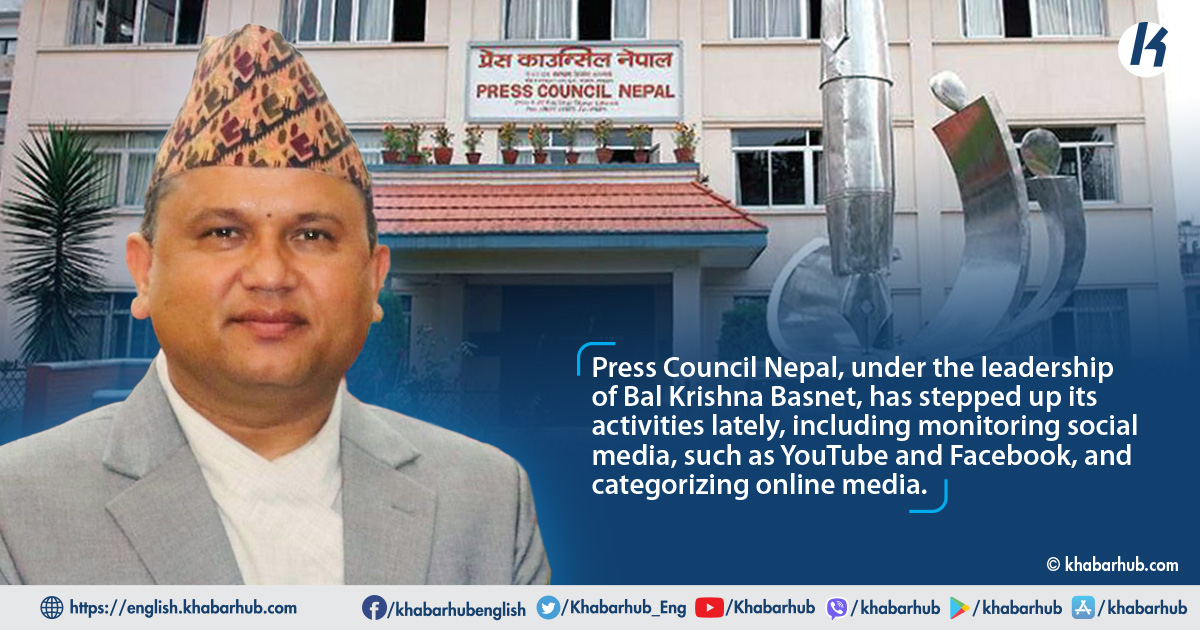
KATHMANDU: The Press Council Nepal (PCN), which has been monitoring and regulating the media sector, has been very active lately.
The PCN team is engaged in the work of hearing complaints regarding news published/broadcast in newspapers, online, radio and television, monitoring the media, conducting code of conduct awareness programs in districts, creating new guidelines and enforcing them.
The Council has also stepped up its work to manage social media, such as YouTube and Facebook, and to categorize online media.
This has been possible only because of PCN Chairman Bal Krishna Basnet’s efforts and professionalism.
In the last eight months, PCN Chairman Basnet has carried out some remarkable tasks to uplift the status of the Council and journalists have started to feel that the Press Council is the parent organization responsible for the rights and interests of the journalists.
The classification of newspapers, which was stopped three years back due to various reasons, has been recently settled on the initiatives of Basnet.
The media sector, too, has praised the work carried out by the PCN members and staff under the leadership of Chairman Basnet, who also has a background in law business. The Council is currently working on the broader development of the Nepali media sector.
Basnet’s leadership has been quite successful at the PCN, which is an independent, quasi-judicial and autonomous body.
Even though he was already in the journalism sector, Basnet began to develop a deep desire to become a professional journalist after he graduated in early 2056 BS with a degree in law.
“The reason why I wanted to work in a big media was to place myself at the helm of professionalism,” Basnet says.
Therefore, he started working with Kantipur Publications, which he believes was a great opportunity for him.
Basnet has been involved in journalism for about 25 years and due to his professionalism and maturity, the government led by Prime Minister KP Oli appointed him to the post of PCN Chairman.
Due to Basnet’s professional know-how, the PCN has started working aggressively for the benefit of Nepal’s entire media sector.
It was during his tenure that the PCN decided to blacklist some online outlets for violating the journalism code of conduct.
As soon as Basnet took the lead, he stopped the trend of rampant online registration to ensure professionalism.
A permanent resident of the Dolakha district, he started his career as a journalist in 2052 BS.
He has also taken one year of training from Nepal Press Institute (NPI).
He has written quite a significant number of news on judicial corruption, which includes the infamous Robinson case, sugar case, issue of Parmananda Jha on a drug case, among others.
It may be noted that two judges Supreme Court lost their jobs due to his investigative story on the Robinson issue.
Basnet had also been a member of the Federation of Nepali Journalists (FNJ) since 2055 BS. He has worked at the leadership level in the Federation because of which journalists and his contemporaries call him a diligent, creative, conscientious, outspoken thinker, and accomplished professional.
“In order to make journalism professional, we are trying to do our best for the rights and interests of journalists,” said Basnet.
“We have also taken action against those doing wrong. The State becomes responsible only if the journalism profession becomes responsible.”



Comment