




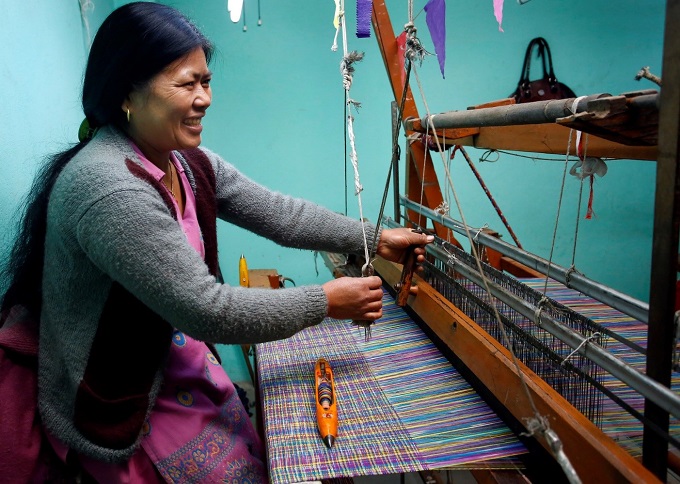
POKHARA/GENEVA:The EU-Nepal Trade and Investment Programme (TIP), implemented by International Trade Center (ITC), organized a workshop to boost the Pashmina business in Nepal, in Pokhara, from March 25-26, 2021.
The pashmina stakeholders along the entire value chain from fiber production to manufacturing and export validated the Pashmina Sector Export strategy to strengthen backward integration in Nepal.
The EU-Nepal TIP facilitated views from more than 40 stakeholders from federal and provincial governments, public institutions, business associations and development partners, to validate the plan of action of the Pashmina Export Strategy, focusing on backward linkages and fiber production. Participants also discussed the pilot support activities in Mustang planned under the EU-Nepal TIP to create business synergies between the manufacturers and the goat farmers harvesting Pashmina fiber.
Farmers harvesting Pashmina fiber in the remote parts of upper Himalaya can now look forward to an increased support for their endeavors that will result in increased quantity and improved quality of the fiber and most importantly likely higher prices.
Mr. Dinesh Bhattarai, secretary at Ministry of Industry, Commerce and Supplies (MoICS), chaired the consultation along with Mr. Durga Prasad Bhusal, the program’s focal Point and undersecretary, MoICS. Secretary Bhattarai described the EU project as timely and recognized the importance of taking proactive measures to stimulate the sector as it is one of the priority sectors for export development identified by the Government of Nepal in the Nepal Trade Integration Strategy (NTIS). He went on to add that Pashmina is a manifestation of the Nepali identity and culture that is cherished and shared with the rest of the world.
Mr. Olivier Marty, senior trade strategy adviser at ITC, reiterated the need to build consensus and support for the plan of action of the Pashmina Export Strategy. The strategy will focus on establishing a favorable policy and regulatory framework as well as reinforcing the institutional support in order to access markets and prepare for the post-COVID-19 recovery.
The European Union Delegation to Nepal, Mim Hamal, programme manager, highlighted that the Pashmina sector strategy fits perfectly with Nepal’s development objectives as it aspires to graduate from Least Developed Country (LDC) category by 2022 and is fully aligned with government policies, cleaner production as per the EU green deal and farm to fork strategies.
The EU, which opens its single market to Nepali products, is proud to host this initiative and believes that the sector has the potential to contribute to the reduction of rural poverty, and create decent jobs for women and youth.
Ms. Sabnam Shivakoti, secretary at the Ministry of Land Management, Agriculture and Cooperative, Gandaki Province, stressed that the Chyangra Pashmina sector has tremendous opportunities in product development and emphasized that the strategy will help address the challenges in fiber production, linking the farmers to the industry. She also assured the Ministry is committed to work with all stakeholders.
Mr. Lopsang Chhompel Bista, president of Lo Ghekar Damodar Kunda Rural Municipality, remarked that it is high time for directing interventions to farmers to enhance production and productivity of Chyangra in the region to be able to develop the Pashmina sector. He emphasized the need for linking Chyangra goat production with Nepal’s Pashmina Industry.
The Pashmina Sector Export Strategy includes a detailed five-year plan of action with a set of activities to provide a solid foundation for the growth of the sector, including the development of backward integration. Key to achieving this will be to strengthen the capacities of pashmina – related trade support institutions, and increasing the abilities throughout Nepal’s pashmina value chain, with a view to connect farmers to the market. To support these efforts, the EU-Nepal Trade and Investment Programme will work closely with and capacitate Chyangra pashmina farmers to benefit from fibre value-addition and improved competitiveness.





Comment