




One of the existential challenges facing the free world today is its disunity over emerging technologies.
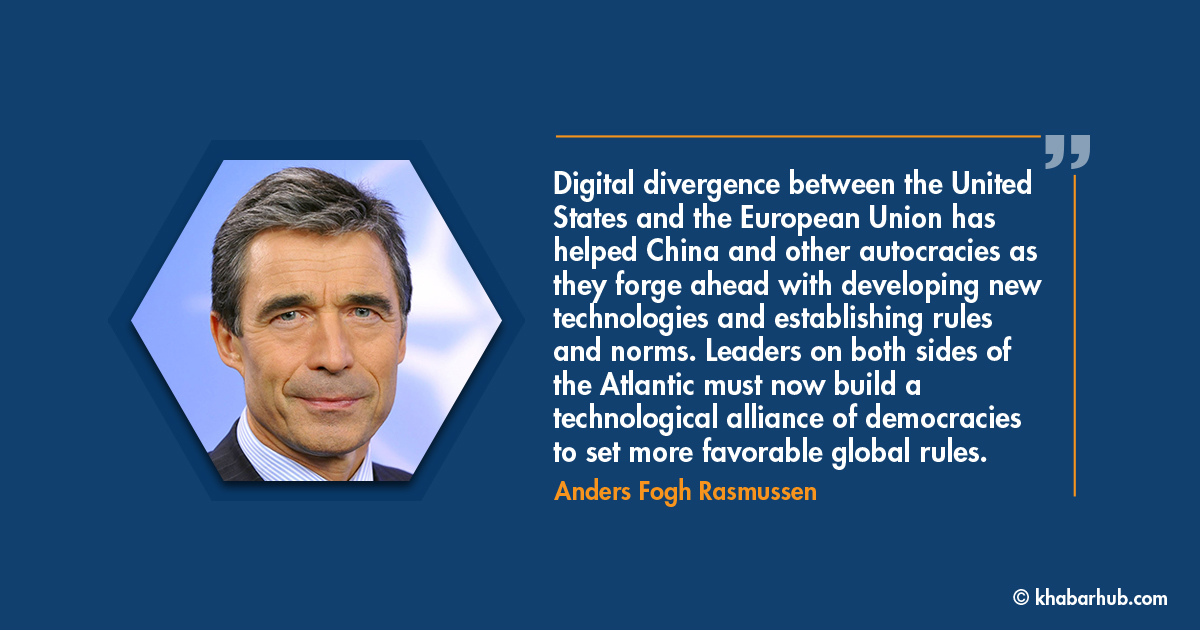
Divergence between the United States and the European Union in this area has helped China and other autocratic regimes as they forge ahead with developing new tools and establishing rules and norms that will guide many aspects of our lives, economies, and security for generations.
Russian President Vladimir Putin is absolutely right: “Whoever becomes the leader in this [artificial intelligence] sphere will become the ruler of the world.”
US President Joe Biden’s agenda for strengthening democracy at home and abroad presents an opportunity to close this strategic gap.
Leaders on both sides of the Atlantic must seize it, and build a technological alliance of democracies that will win the digital race and set the global rules in our mold.
Authoritarian regimes and their surveillance states have far easier access to metadata, so we need to work together to compete.
In their election platform, Biden and Vice President Kamala Harris pledged to convene a global “Summit for Democracy” later this year.
It’s an excellent idea, and mirrors the Copenhagen Democracy Summit that the Alliance of Democracies Foundation has organized annually since 2018 – with Biden himself delivering the first keynote address.
But several questions remain regarding the format of Biden’s summit, whether more wayward democracies will be invited, and what concrete tasks participants might agree to take forward from the meeting itself.
On the last point at least, Biden now has the makings of a blueprint. Since late 2018, the US National Security Commission on Artificial Intelligence, an eminent group of technology leaders chaired by former Google CEO Eric Schmidt, has developed a series of recommendations that “comprehensively address the national security and defense needs of the United States” when it comes to AI.
The Commission recently published its final report to the president and Congress. Europeans and America’s other democratic allies should read and act upon it, too.
When I addressed the Commission’s conference at the end of 2019, I argued that America’s trump card over China and Russia is its ability to build partnerships around the world.
I am therefore pleased that one of the report’s central recommendations is for the US to build an “Emerging Technology Coalition” to establish democratic norms and values and coordinate policies to counter the adoption of digital infrastructure made in China.
This coalition would also launch an “International Digital Democracy Initiative” to develop, promote, and fund the adoption of AI and associated technologies that accord with democratic values and advance the interests of our free societies.
The free flow of data within a confidence-enhancing framework would be the single biggest boost that liberal democracies’ AI development could receive
This is the sort of positive agenda we need. But it will succeed only if transatlantic and Pacific partners start to realign themselves on some critical questions relating to emerging technologies, in particular concerning two commodities that many regard as the new oil: data and semiconductors. We need to develop a new democratic consensus on both.
On data and data protection especially, it is the US that has grown out of sync with the rest of the free world. Japan has adopted similar standards to the EU’s so that data can flow freely, and the United Kingdom is committing to a similar post-Brexit regime.
Japan used its G20 presidency in 2019 to push for a global data-flows deal, but, despite some progress, China’s objections stymied the effort.
The free flow of data within a confidence-enhancing framework would be the single biggest boost that liberal democracies’ AI development could receive. Authoritarian regimes and their surveillance states have far easier access to metadata, so we need to work together to compete.
Likewise, the recent global semiconductor shortage and the ensuing shutdown of car factories around the world have highlighted our dependence on production plants in Taiwan and South Korea.
They already have the necessary know-how and global supply chains, but we should nonetheless continue to find ways within our democratic alliance to support them.
Biden can now apply a similar logic to ensure that the free world emerges on top in the next industrial revolution. But it takes two to tango, and if Europe closes the door on transatlantic tech cooperation, we should not complain when autocrats begin to set the rules.
Moreover, we need to build a democratic preference zone for both semiconductors and the critical raw materials and rare earths that will fuel our green and technological revolutions.
We know that Biden is personally committed to building transatlantic solutions to technological challenges. I saw this firsthand in 2018 when we co-founded the Transatlantic Commission on Election Integrity.
We agreed that it was not enough for the US to look back at Russian interference in the 2016 presidential election, or for Europe to prepare for its multitude of elections in a silo.
Rather, our aim was to connect the efforts of democratic allies and prepare for future waves of election meddling, including those that deploy AI methods such as deepfake videos.
Biden can now apply a similar logic to ensure that the free world emerges on top in the next industrial revolution. But it takes two to tango, and if Europe closes the door on transatlantic tech cooperation, we should not complain when autocrats begin to set the rules.
(Anders Fogh Rasmussen, a former NATO secretary-general (2009-14) and former prime minister of Denmark, is Founder of the Alliance of Democracies Foundation)
Copyright: Project Syndicate






Comment